



Upkeep
WoodSeal or stain about every 2 to 3 years
CompositeWash as needed; no staining
Decks
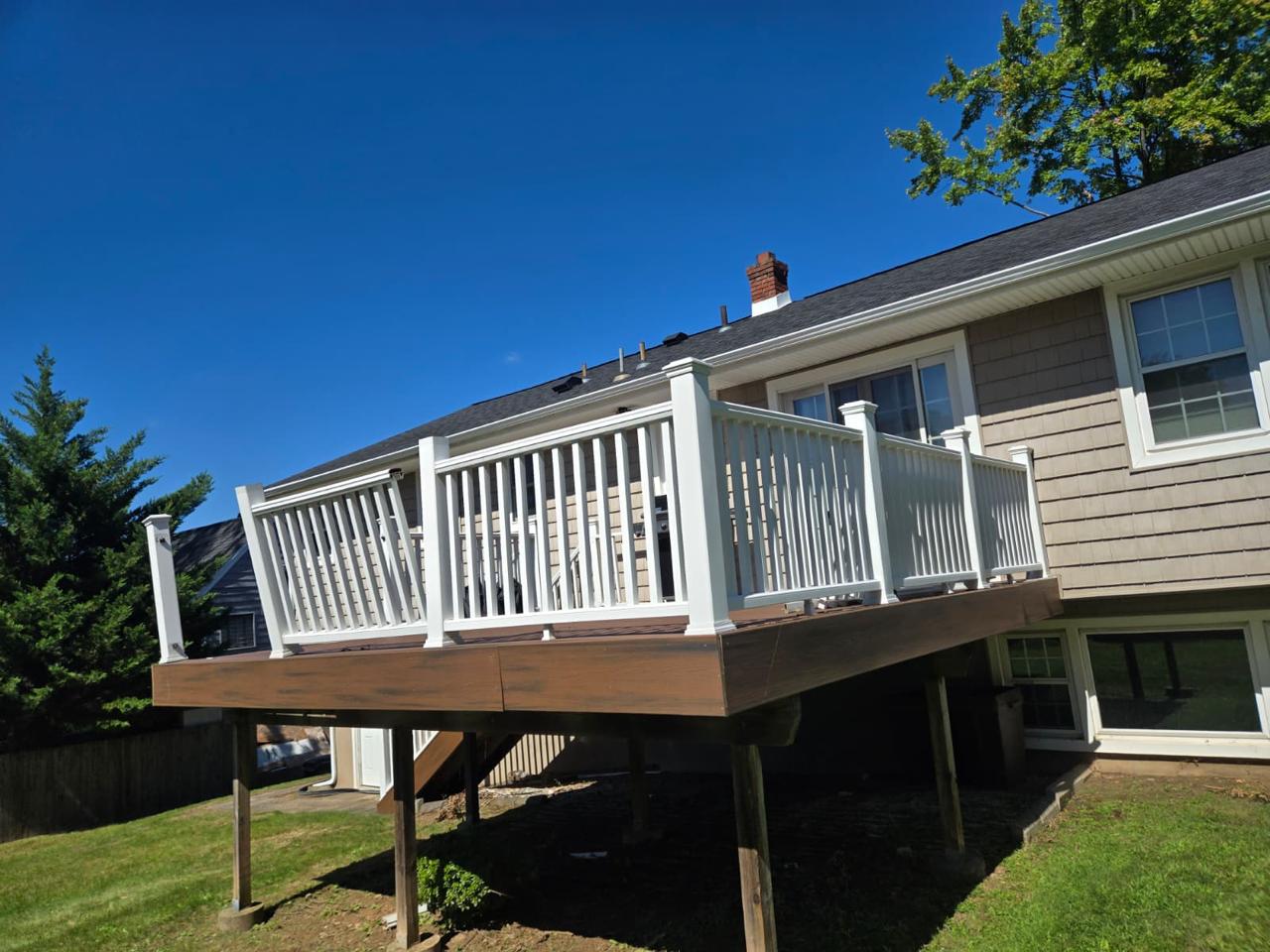
Eagle 1 Construction builds, rebuilds and repairs decks across North Jersey: new wood and composite decks, replacement boards and railings, stairs, restoration of older decks, and curved and patterned layouts. The photos on this page come from our own jobs in Wyckoff, West Orange, Wayne, Hackensack, Pompton Plains, Oradell, Clifton and Ridgewood.
These six stages come from photos of a restoration job in Pompton Plains. They are shown in the order this kind of work usually goes, from the old deck to the finished surface.
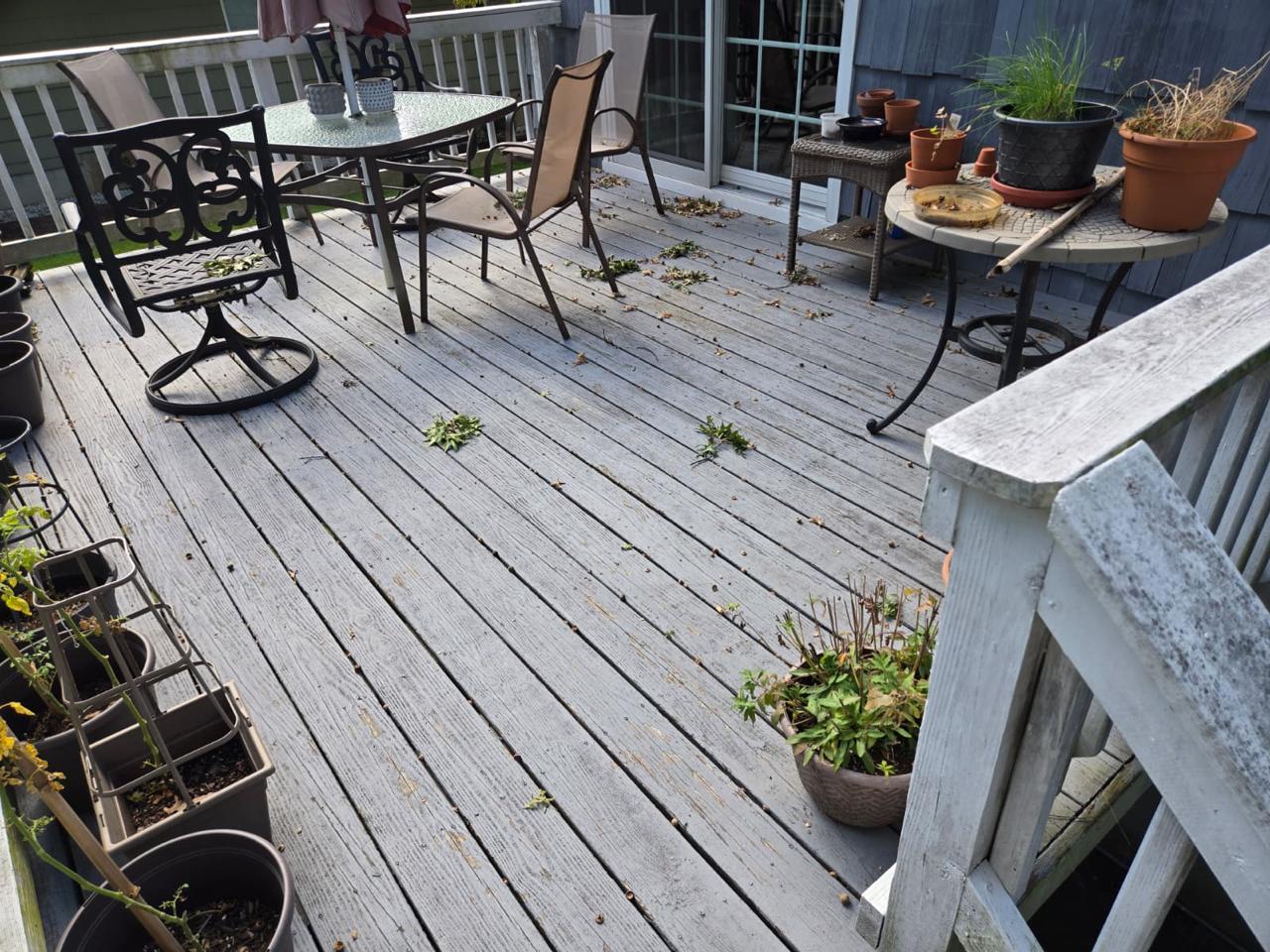
The job starts with a look at what is there. In this photo the boards are weathered gray, patio furniture stands on them and the top of the railing is worn. Before any cleaning, the boards, the railing and the frame under them are checked, because a restoration only works on sound wood.
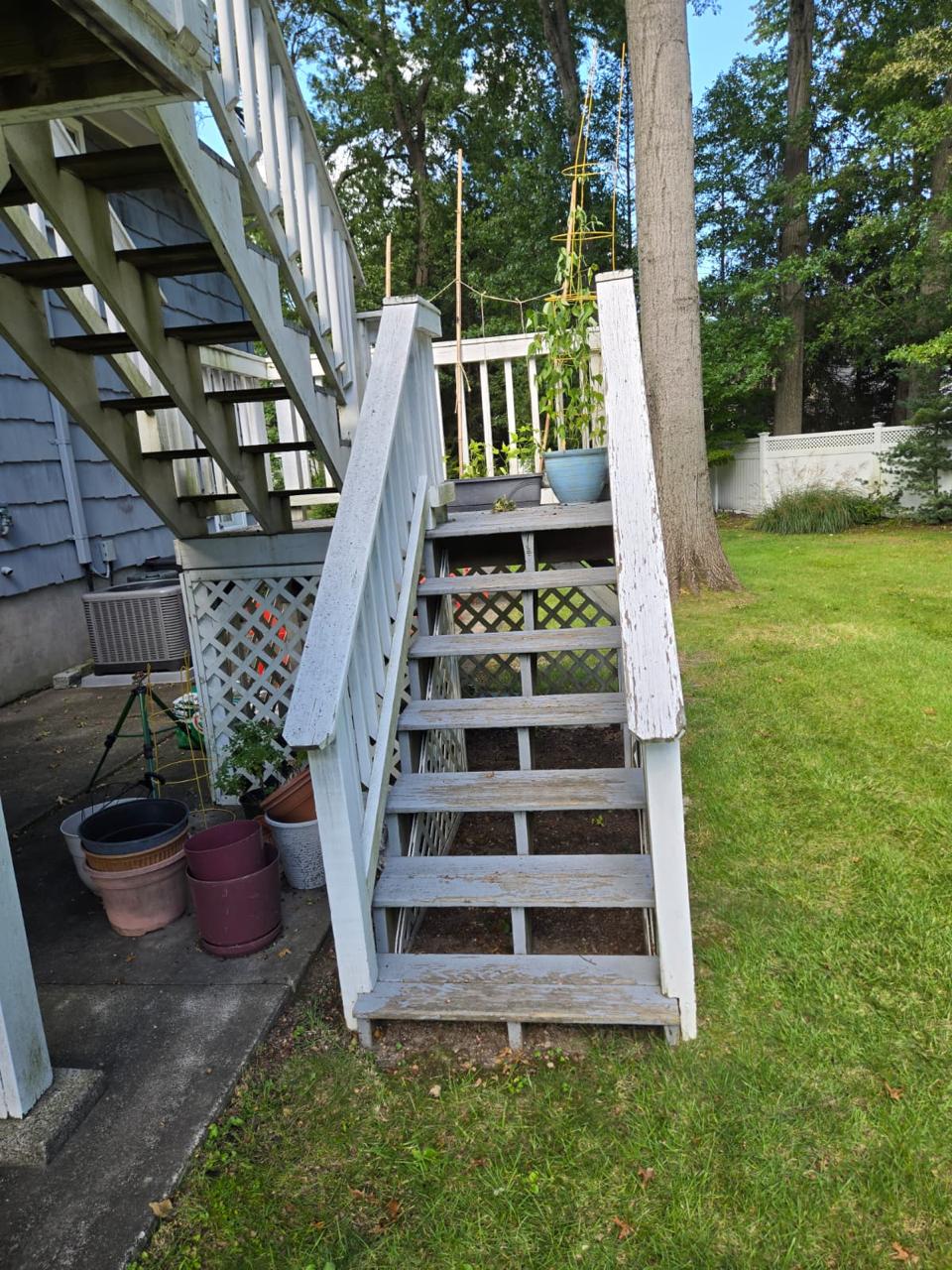
Stairs wear faster than the deck itself. These old wooden stairs have worn white paint and open risers, with a lattice skirt beside them. Treads, stringers and the railing along the stairs are checked on their own.
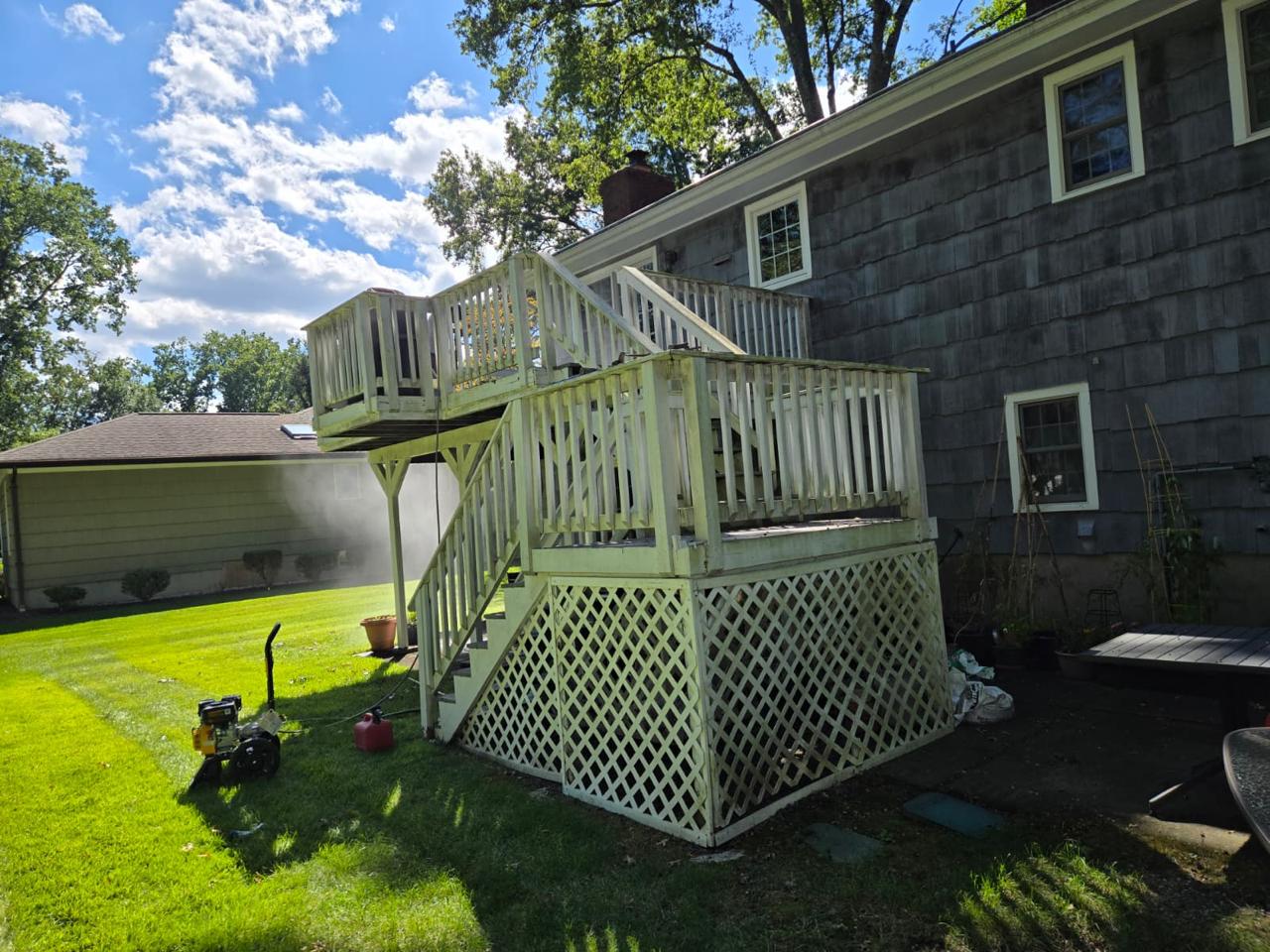
A pressure washer sits on the lawn next to the old deck. Cleaning takes off dirt, mildew and loose coating so that a new finish can hold. On wood it is done with care, since too much pressure or a nozzle held too close can fuzz or etch the surface.
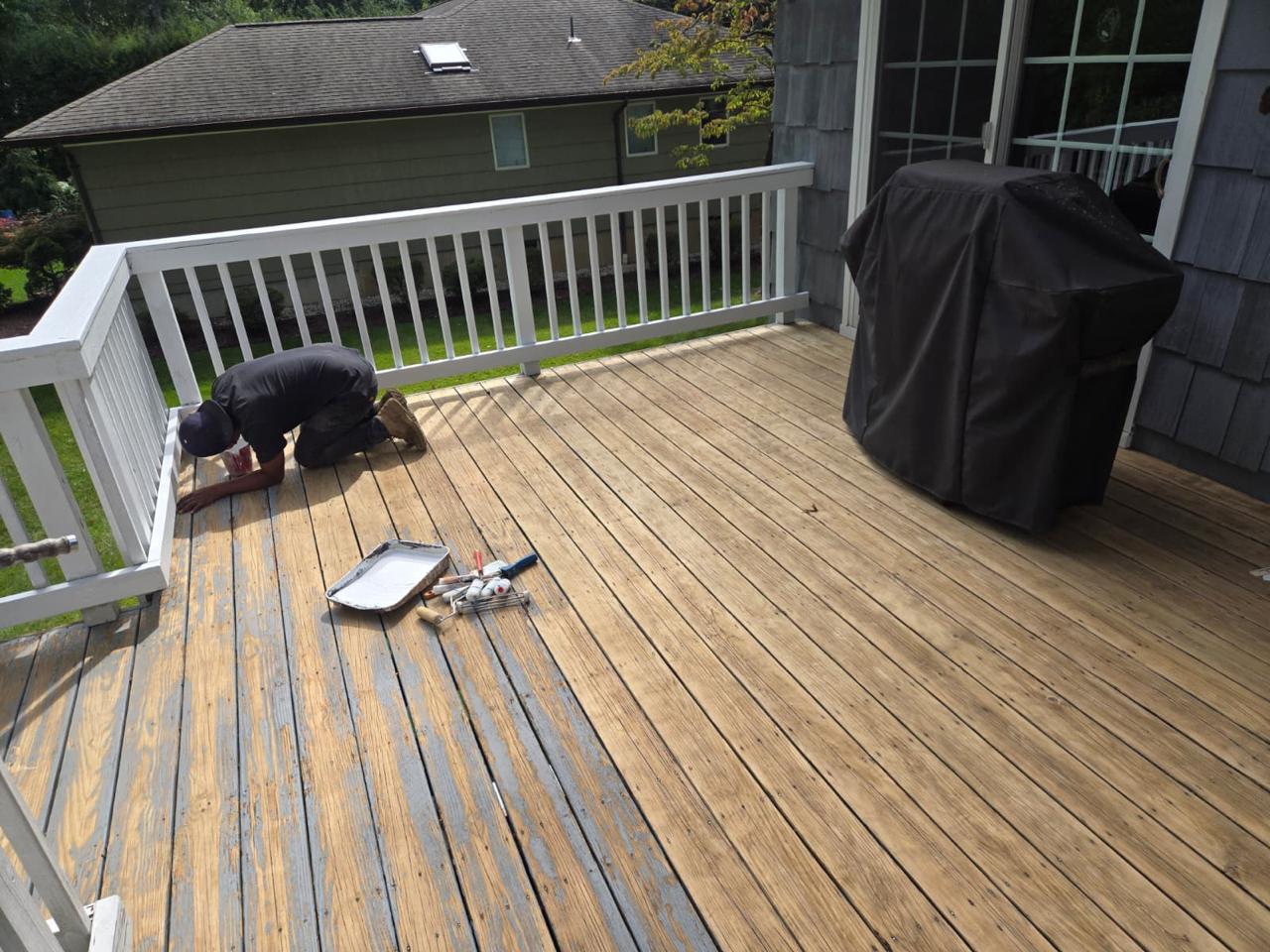
A worker kneels on the boards with a paint tray and rollers. Peeling or loose coating is dealt with first, and the new coat goes on a sound surface, because a coat applied over a failing one fails with it.
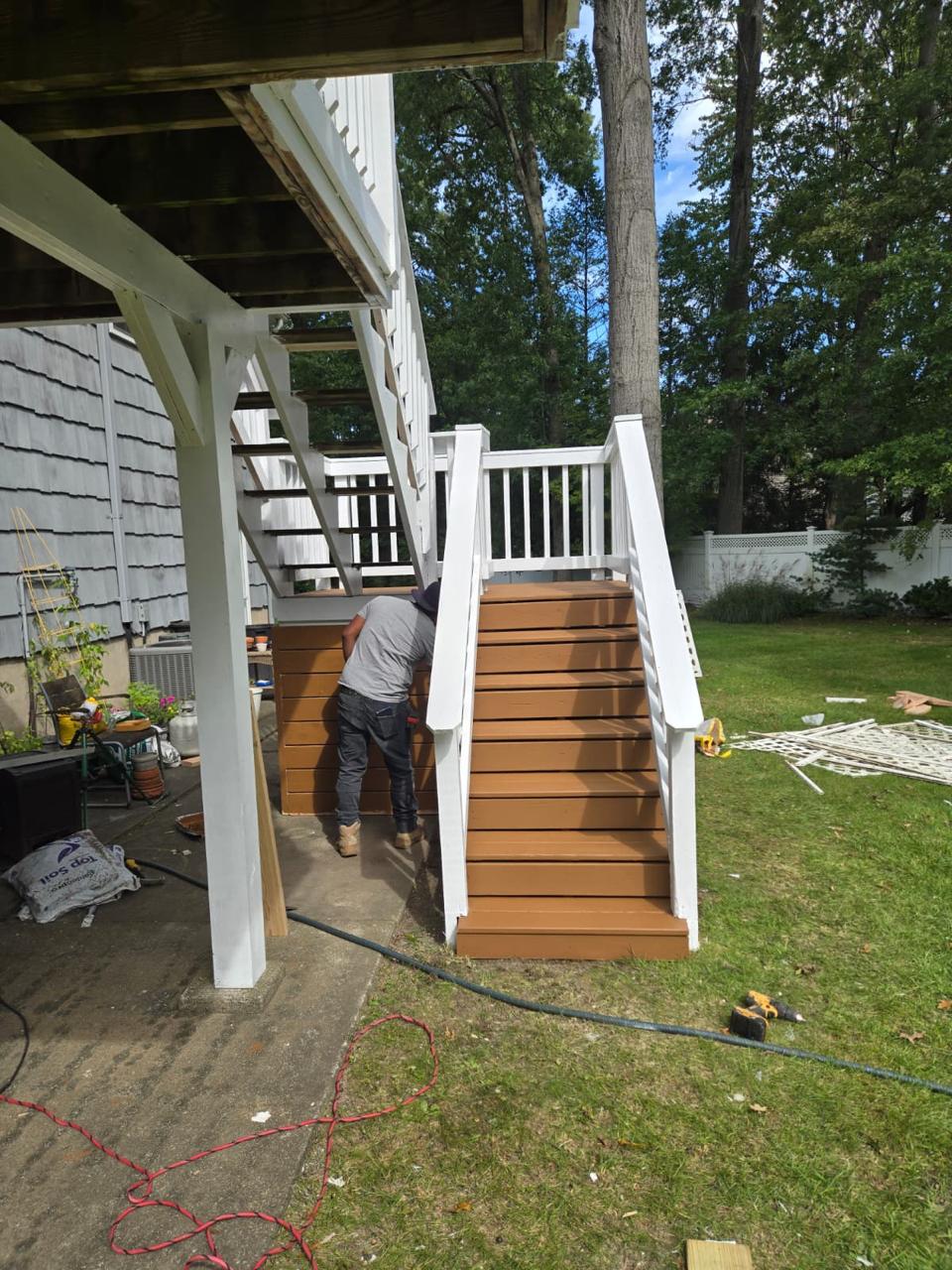
The stairs now have brown treads and white side railings, and a worker is finishing a panel under the deck. Stairs, railings and skirting are finished along with the deck so the whole structure matches.
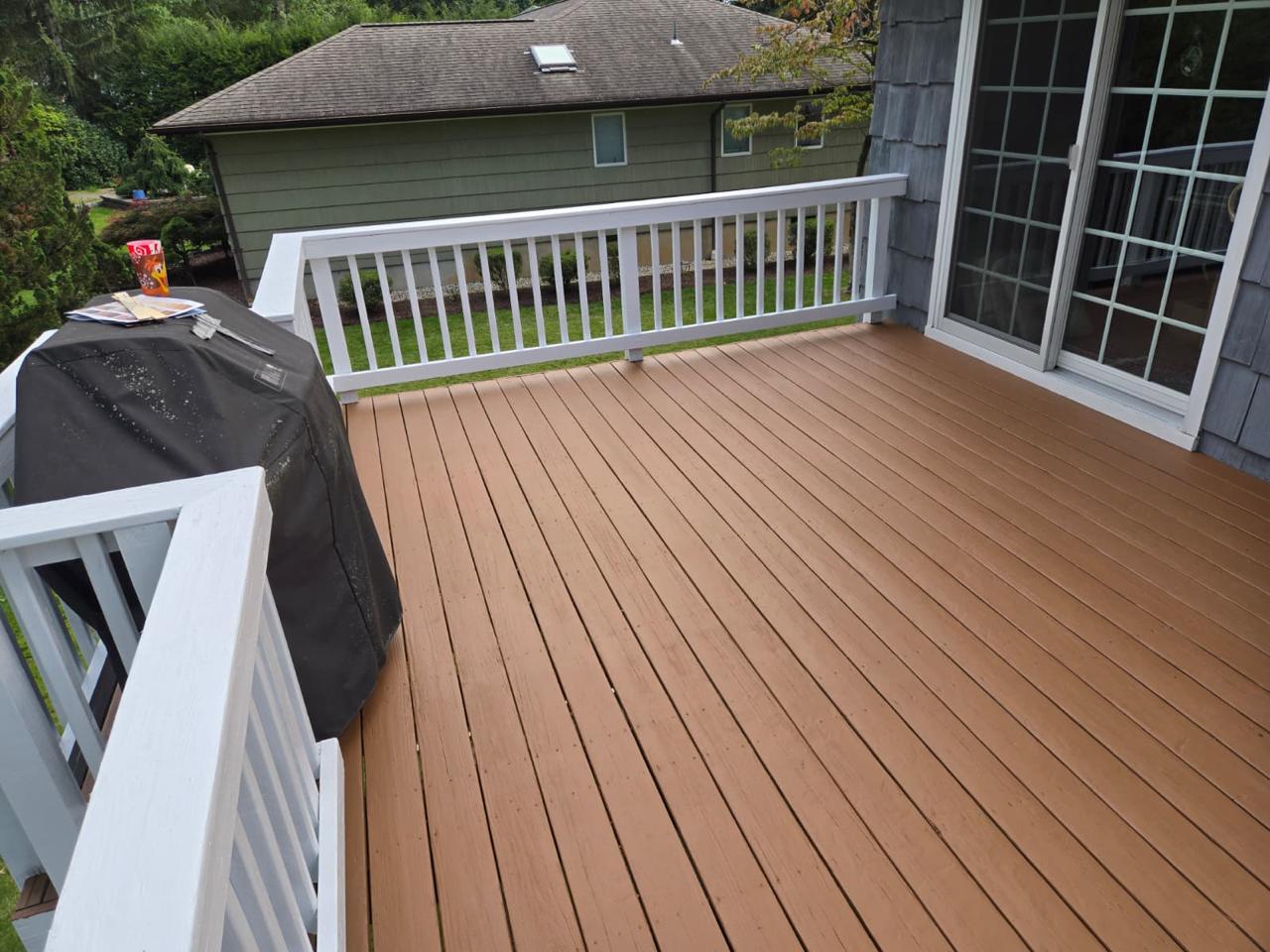
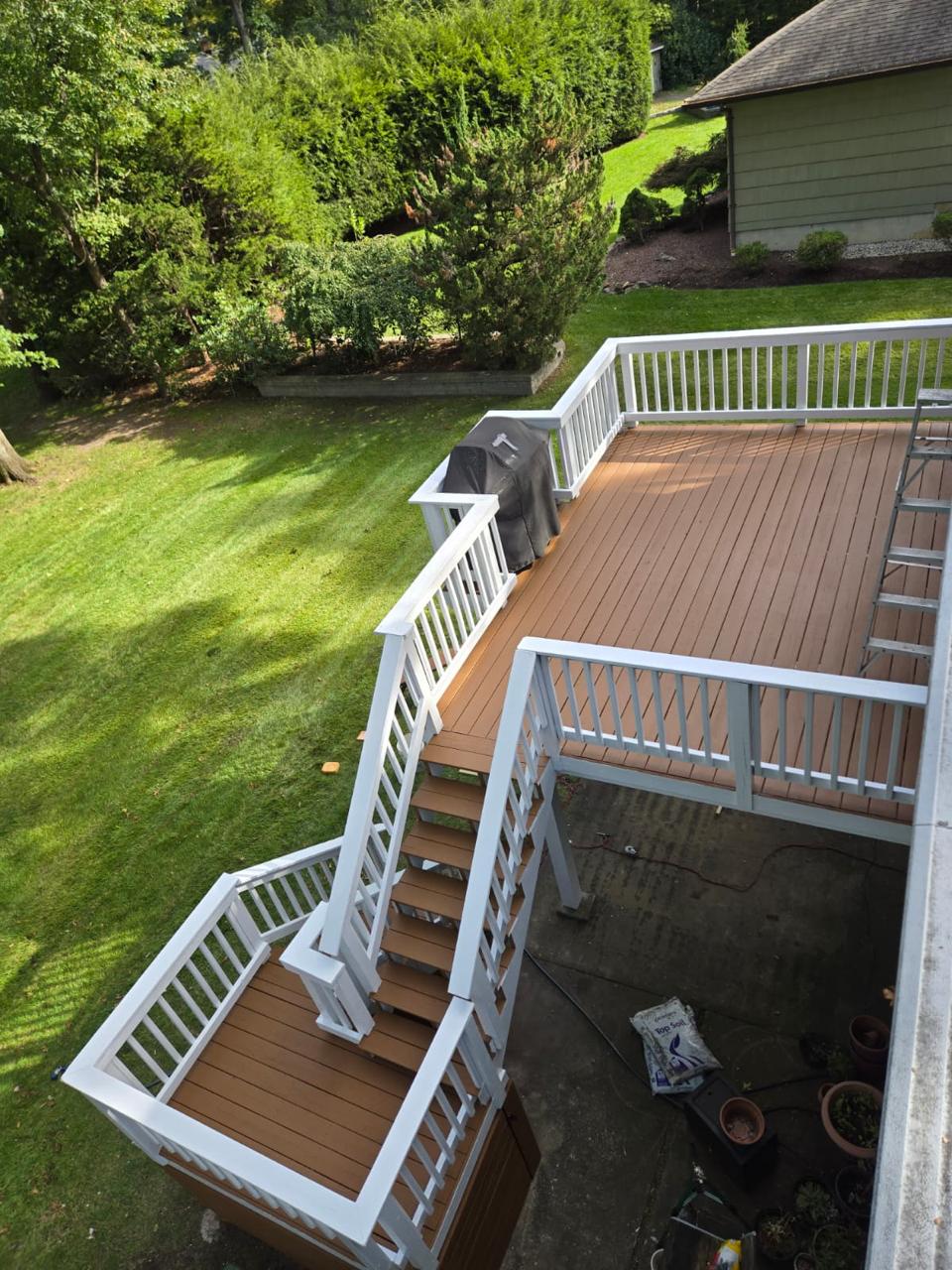
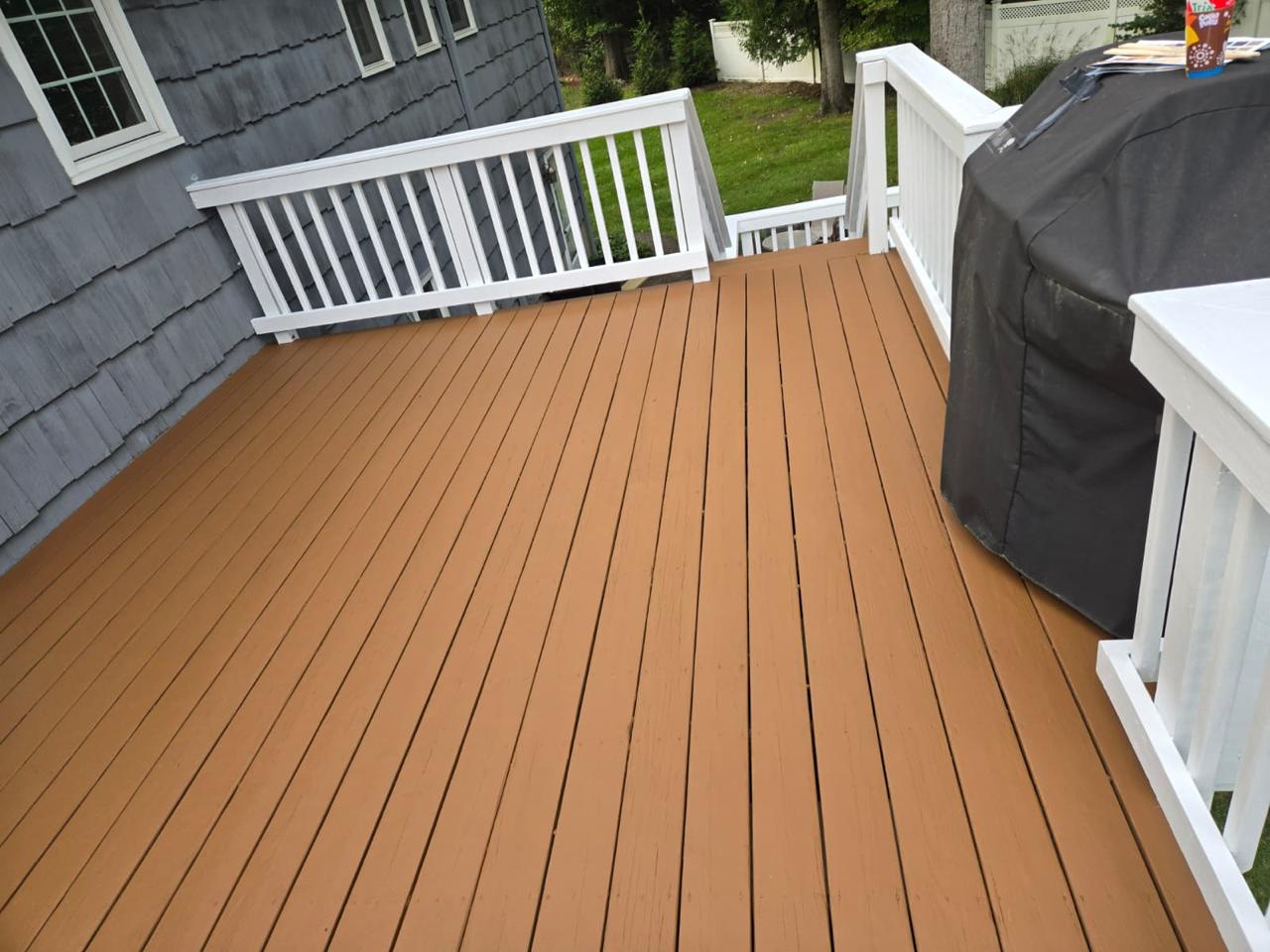
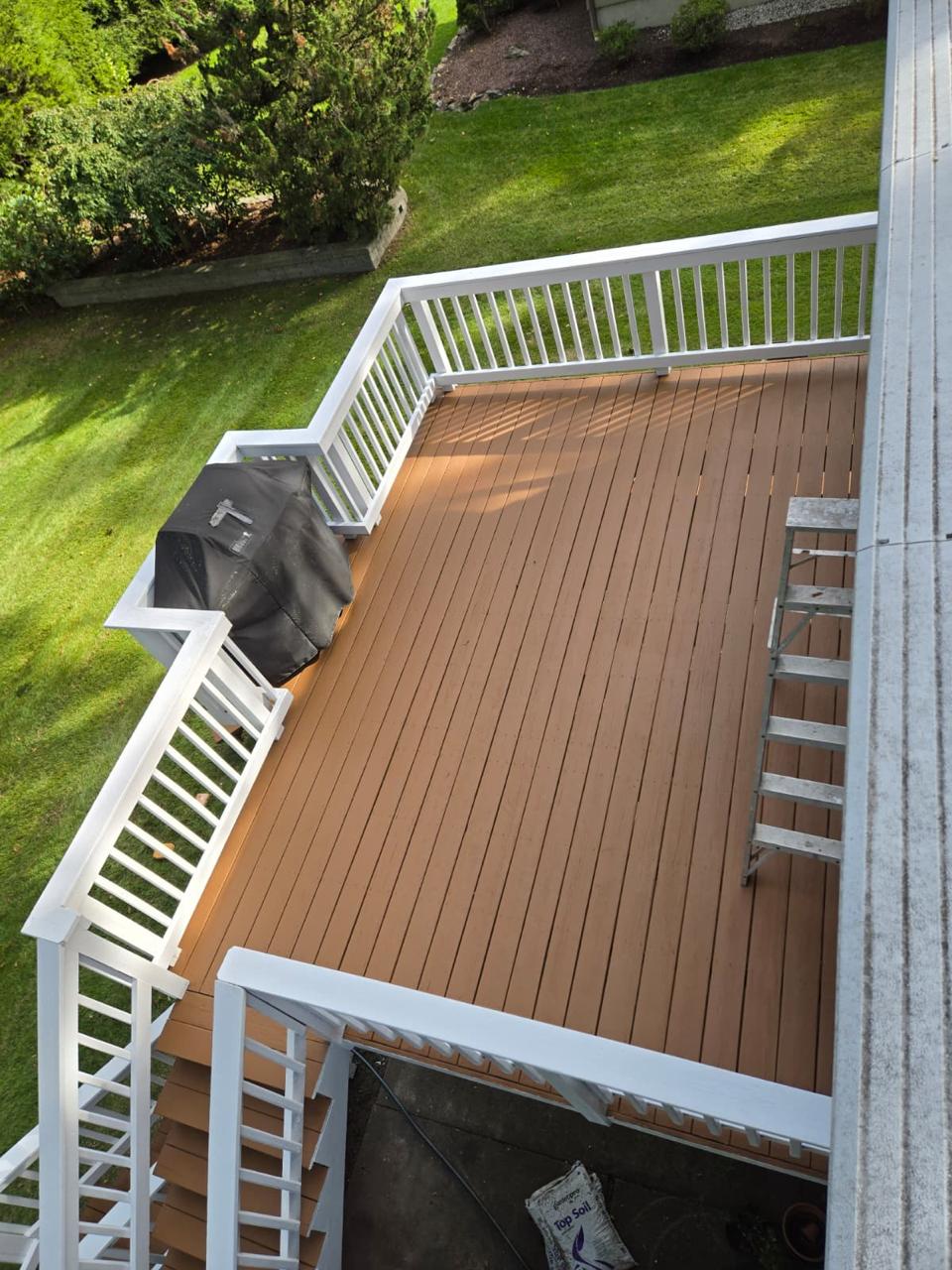
The finished deck has an even brown surface and a white railing against a blue-gray shingle house. The rest of this page explains each part of deck work in turn.
See the full restoration and our other deck jobs: Deck projects
A deck is a structure, not just a floor. From the ground up: footings carry the weight into the soil, posts rise from the footings, beams sit on the posts, and joists run across the beams and carry the deck boards. On the house side, a ledger board is fastened to the frame of the house and carries one edge of the deck. On top are the deck boards, the railing and the stairs.
Most of this is out of sight once the deck is finished. The ledger and its flashing, the connectors, the post bases and the footings matter more to how long a deck lasts than the boards you see, and they are the parts a repair or a resurfacing job has to check first. Under a raised deck there is often skirting or lattice that closes in the space.
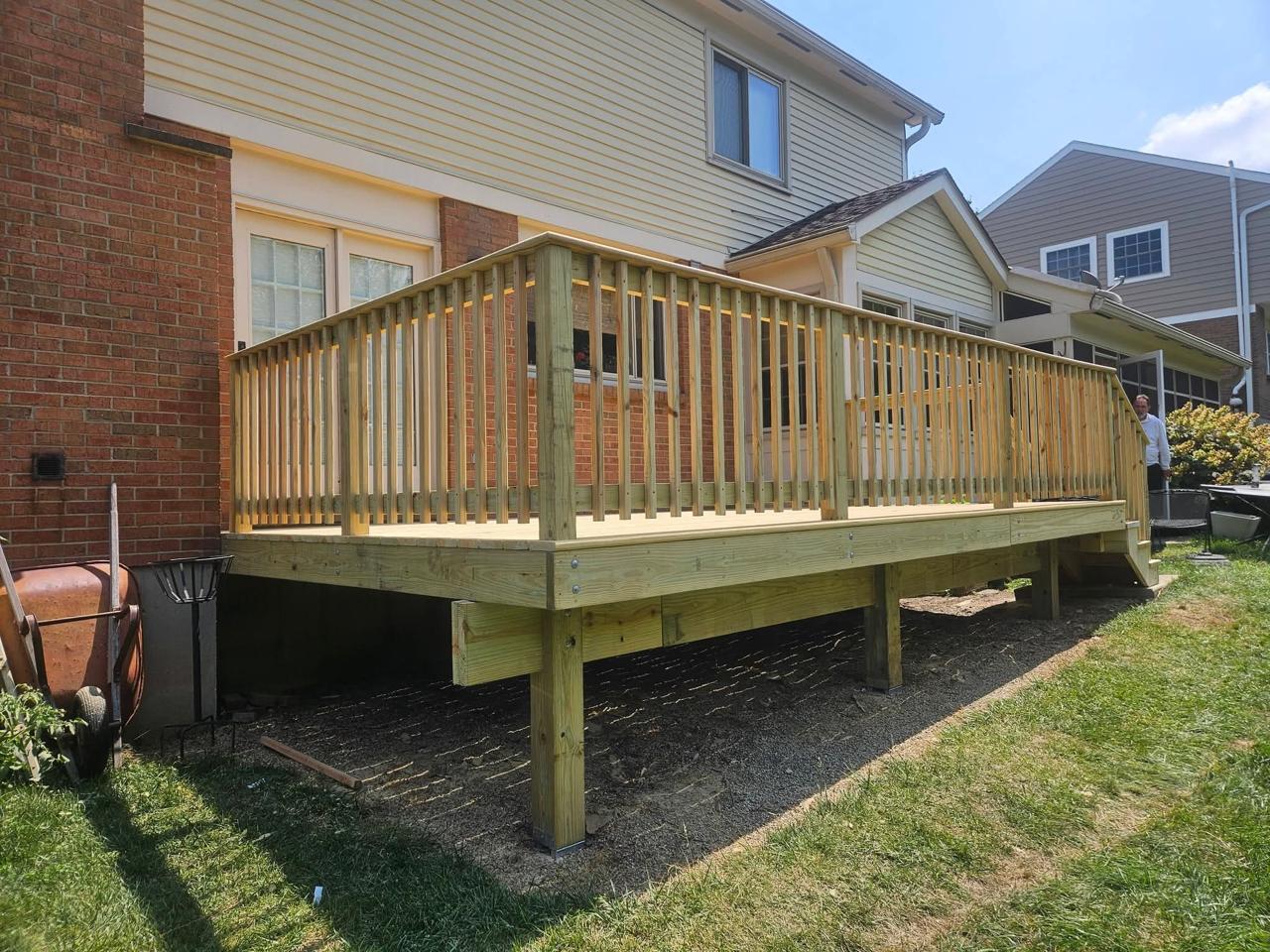
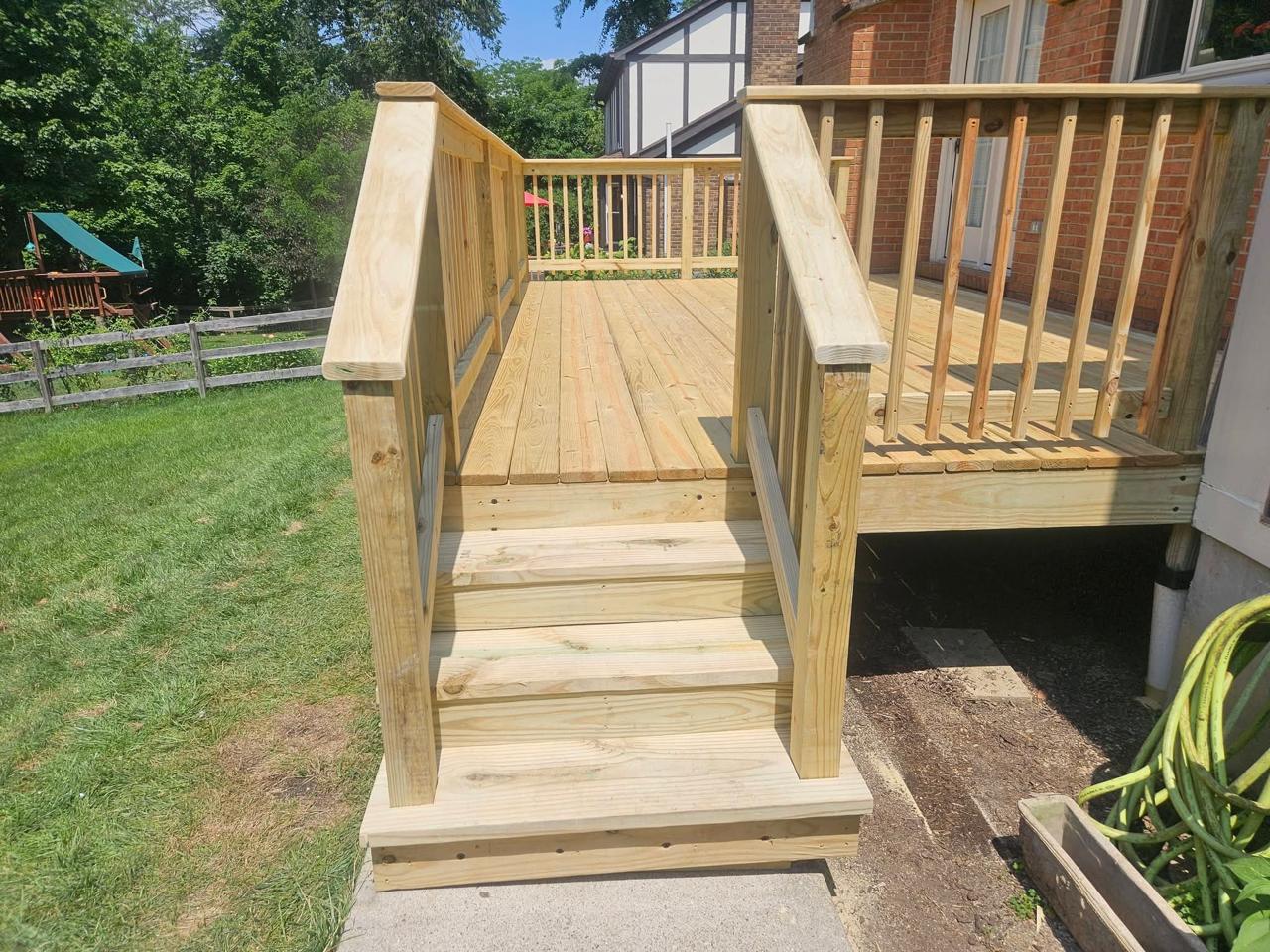
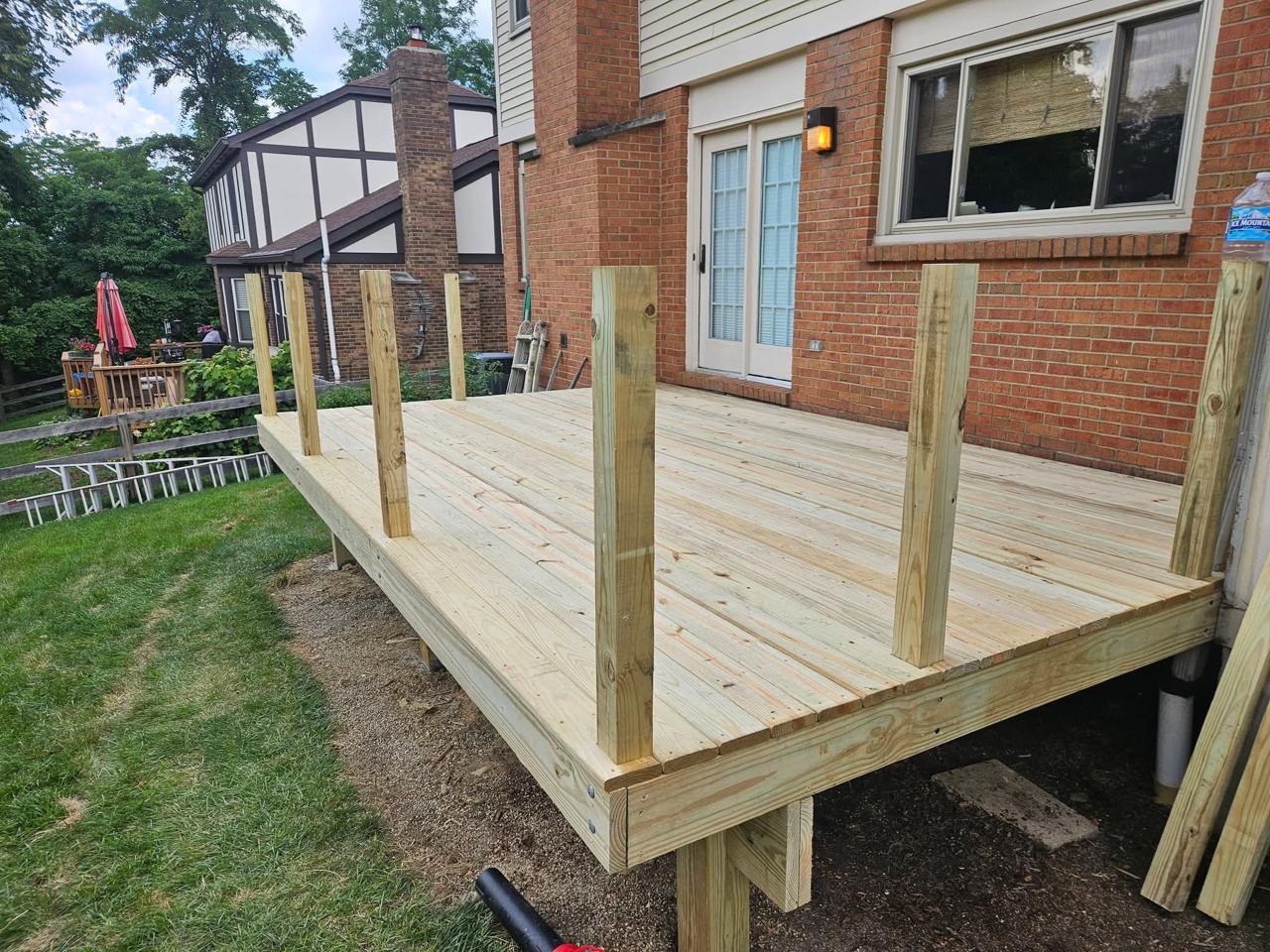
The Clifton photo shows a new wood deck from the side: posts, joists and railing posts, with the bolts and post bases visible at the supports.
Deck work comes in several sizes, and the right one depends on what is under the surface. Eagle 1 Construction builds new decks, replaces worn decks, resurfaces decks whose frames are sound, restores older decks, replaces railings and stairs, repairs boards, posts and framing, and finishes the space under a deck with skirting or lattice.
Each of these has its own chapter below. If you are not sure which one you need, start with the chapter on repair, resurface or rebuild, or send us your town and a photo of the deck from the yard and from above, plus a close-up of any damage. A look at the frame is what decides the answer.
A new deck starts with a plan, not with lumber. The size, the height above the ground, the position of the door it serves, where the stairs land and how it sits against the property line all come before the first footing. Height matters most: a deck close to the ground has different stair and railing needs from one raised high on posts.
The structure follows. Footings are sized and set to carry the load, to a depth that suits local frost conditions, and posts and beams go on them. The ledger is fastened to the frame of the house with bolts or lag screws, not nails, and flashed so water cannot get behind it.
Most new decks need a permit in New Jersey, and the town also checks setbacks and lot coverage, so the paperwork is part of the plan.
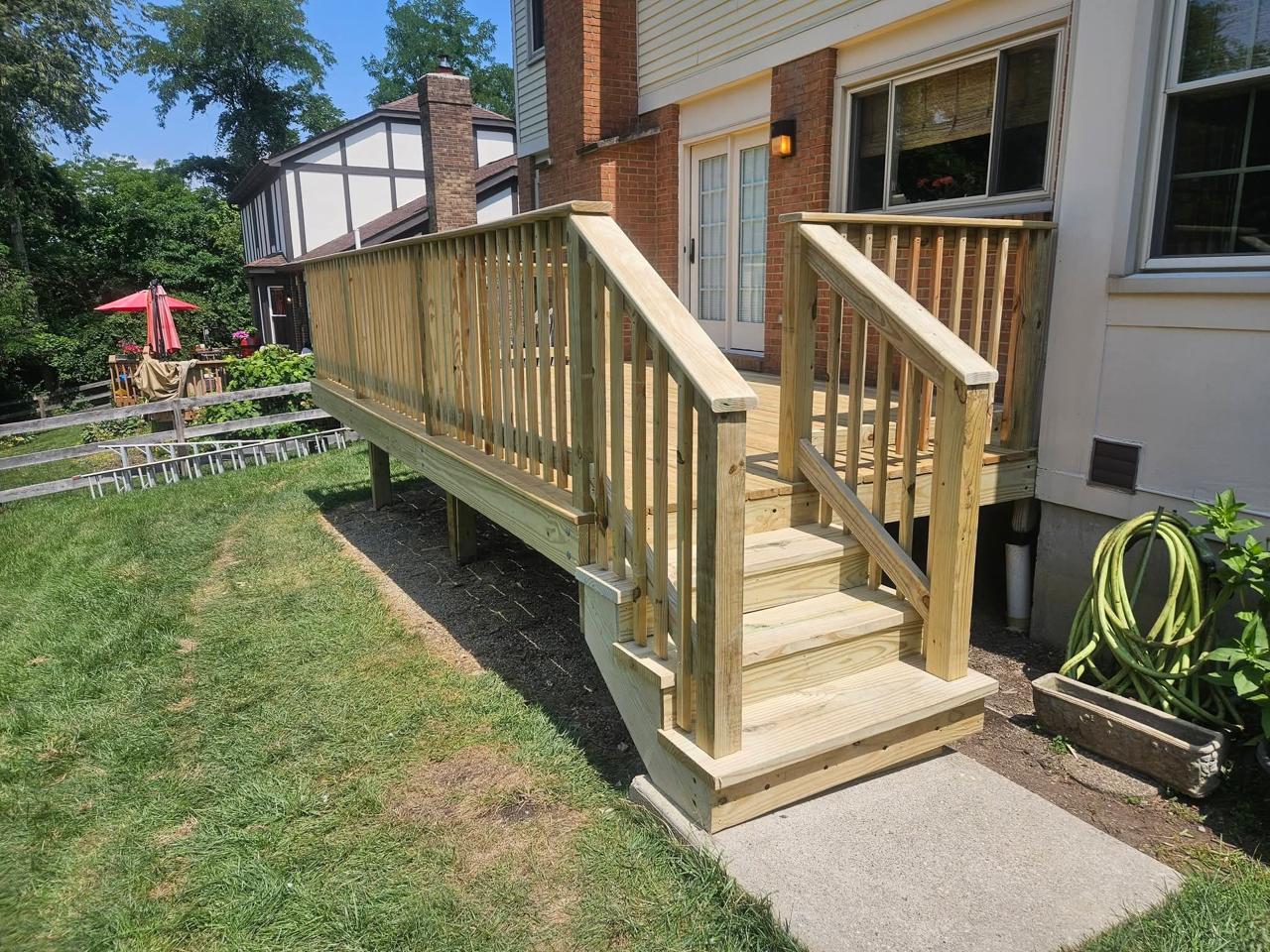
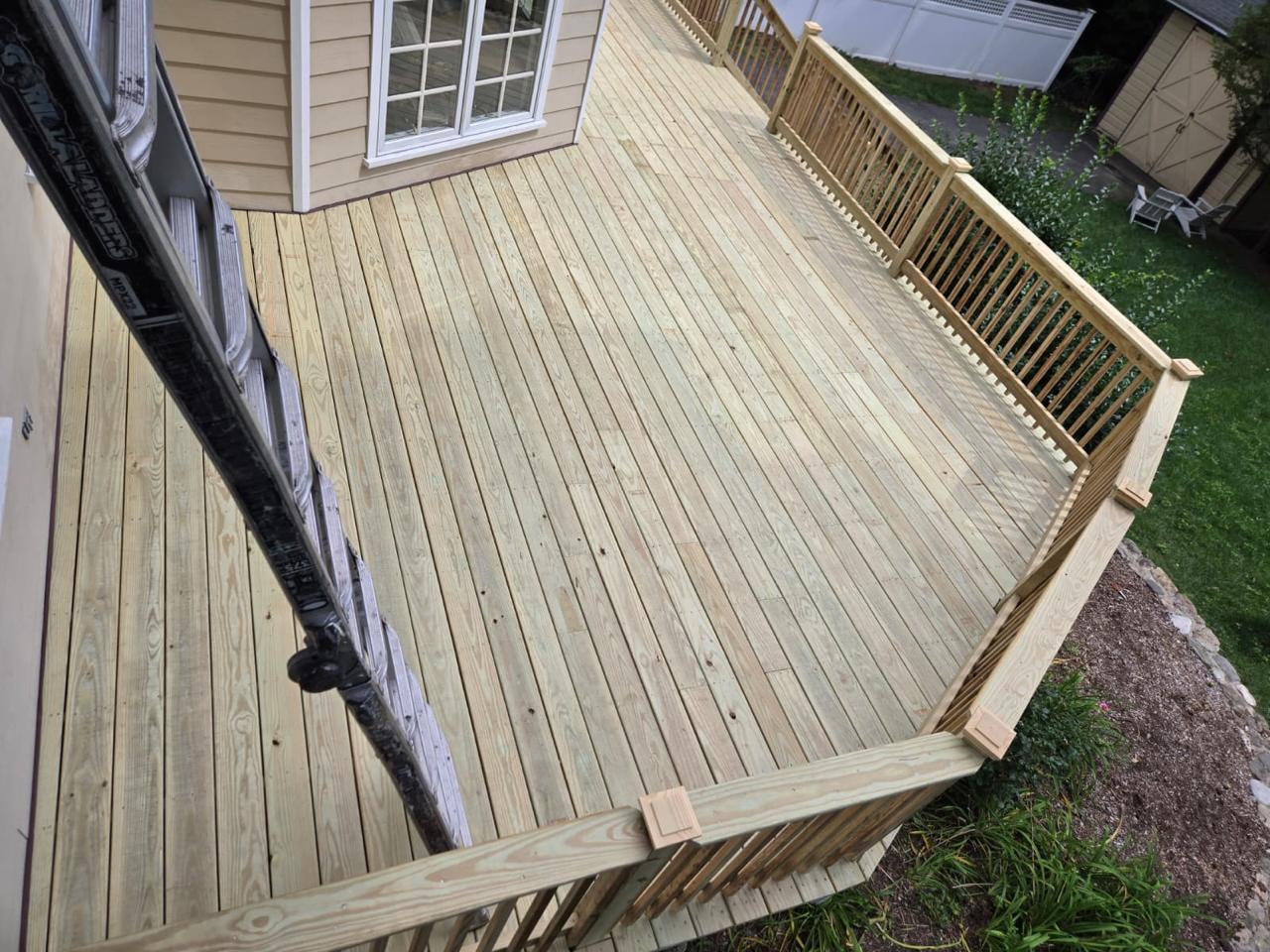
Resurfacing means taking off the old deck boards and laying new ones on the existing frame. It can make an old deck look new, but only if the frame is in good shape. The first job is the frame check, not the boards.
Before boards go on, the frame is looked at closely: joists and beams for rot, the ledger and its flashing at the house, connectors and post bases for rust, and posts and footings for movement or heaving. If the frame fails these checks, rebuilding is the better choice.
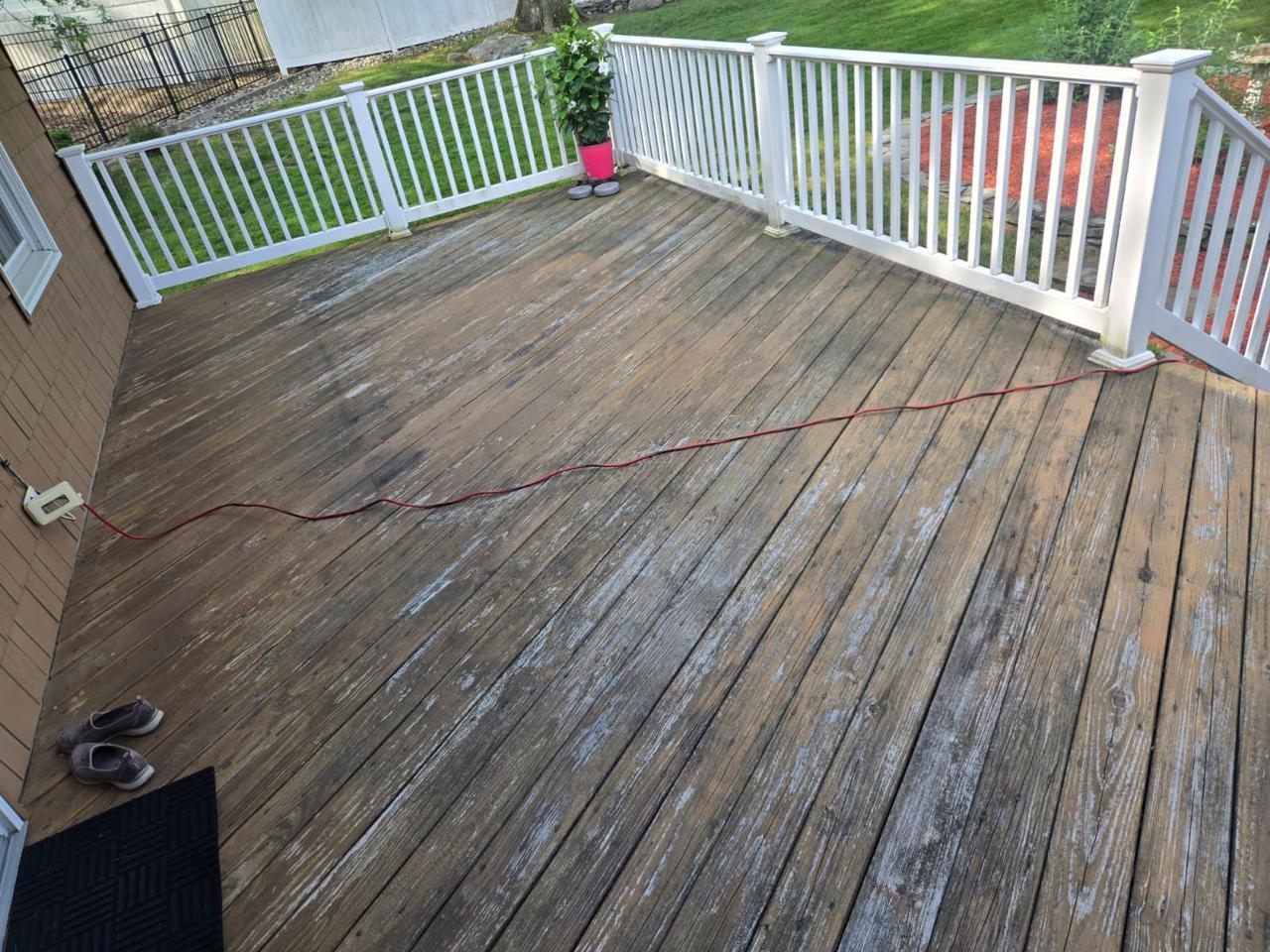
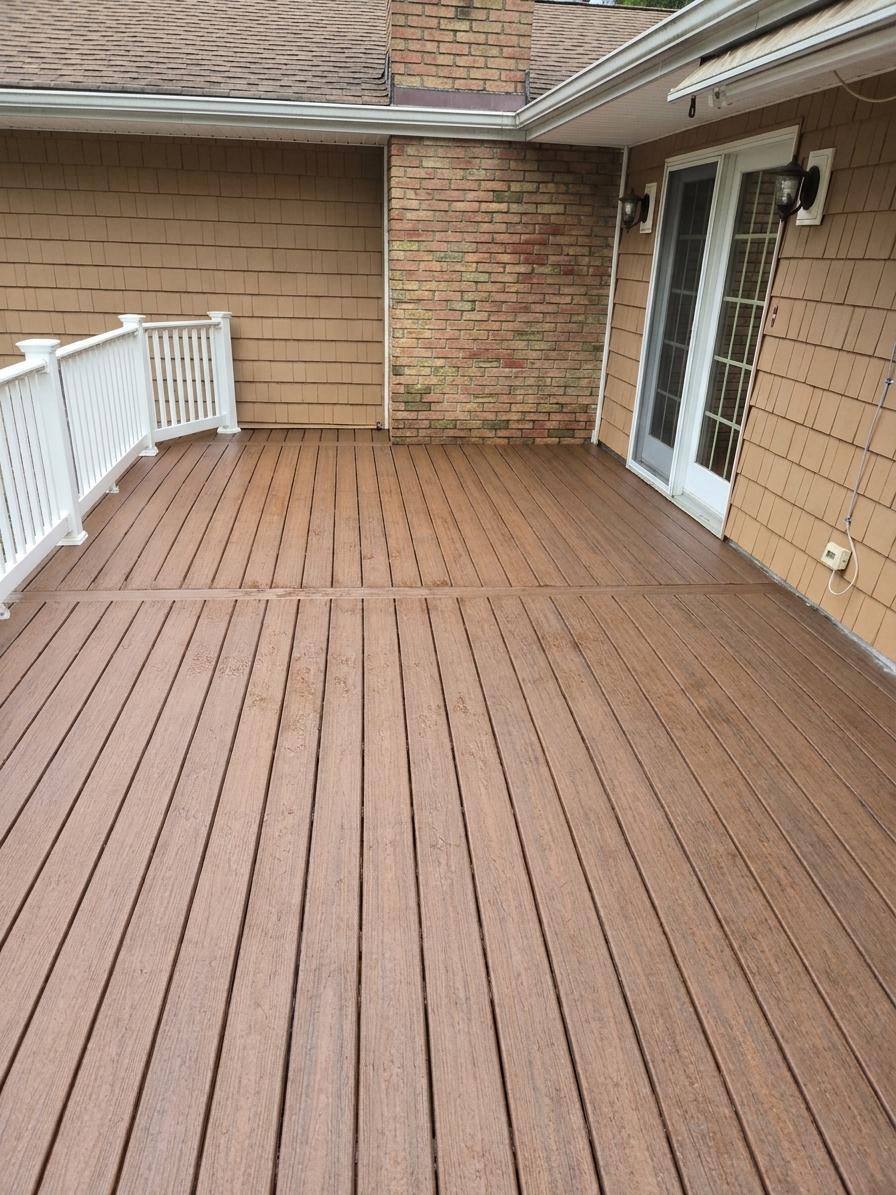
If the frame passes, new boards go down. The Wayne photos show a deck before and after new boards: worn, weathered boards with an uneven finish, then new brown boards with a strip of trim across them.
A deck is rebuilt when the frame cannot be saved, when the layout no longer works or when the deck was never built to current standards. Rebuilding can mean new boards and a new railing on a repaired frame, a new frame under new boards, or a complete tear-out and rebuild.
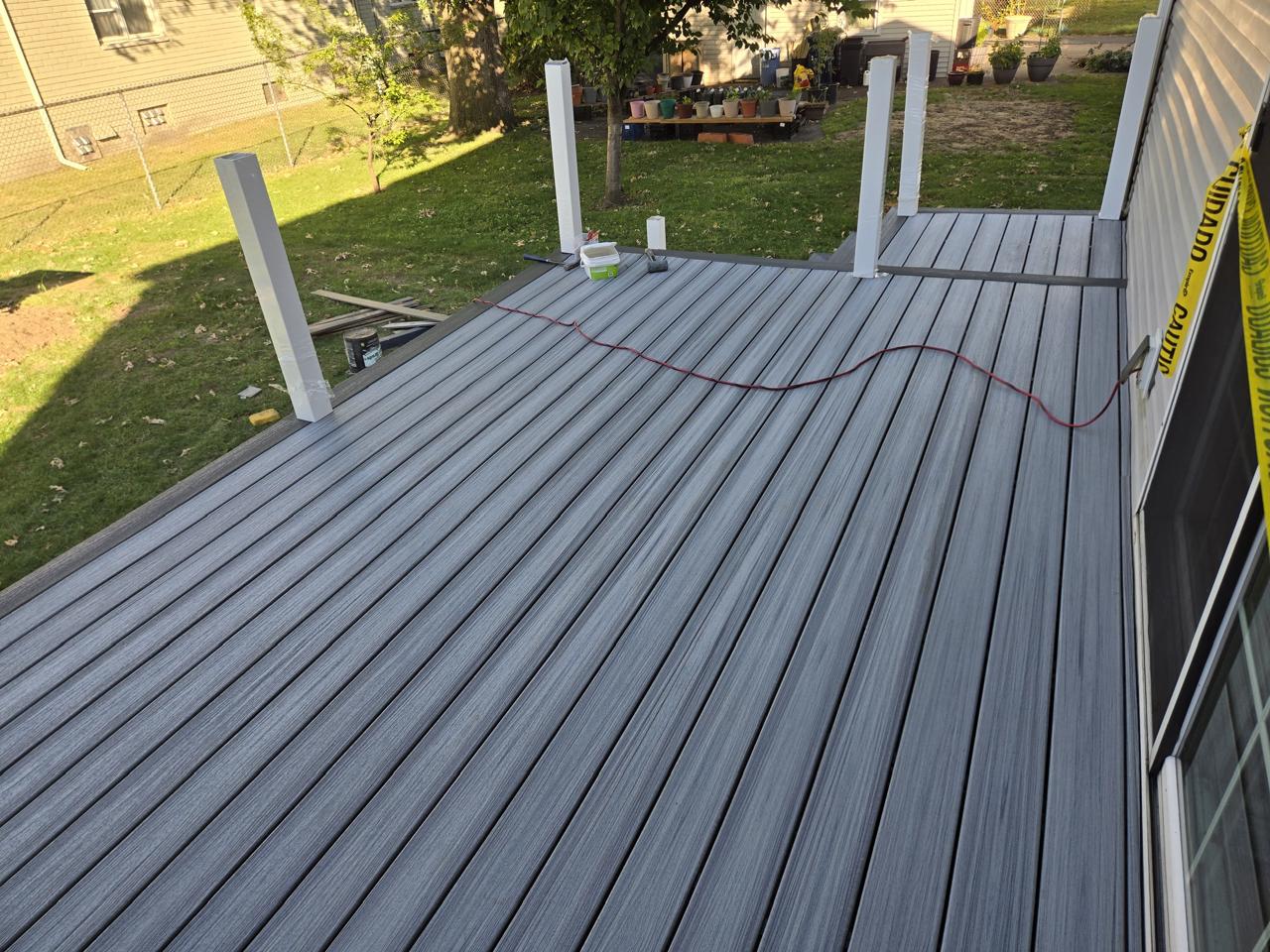
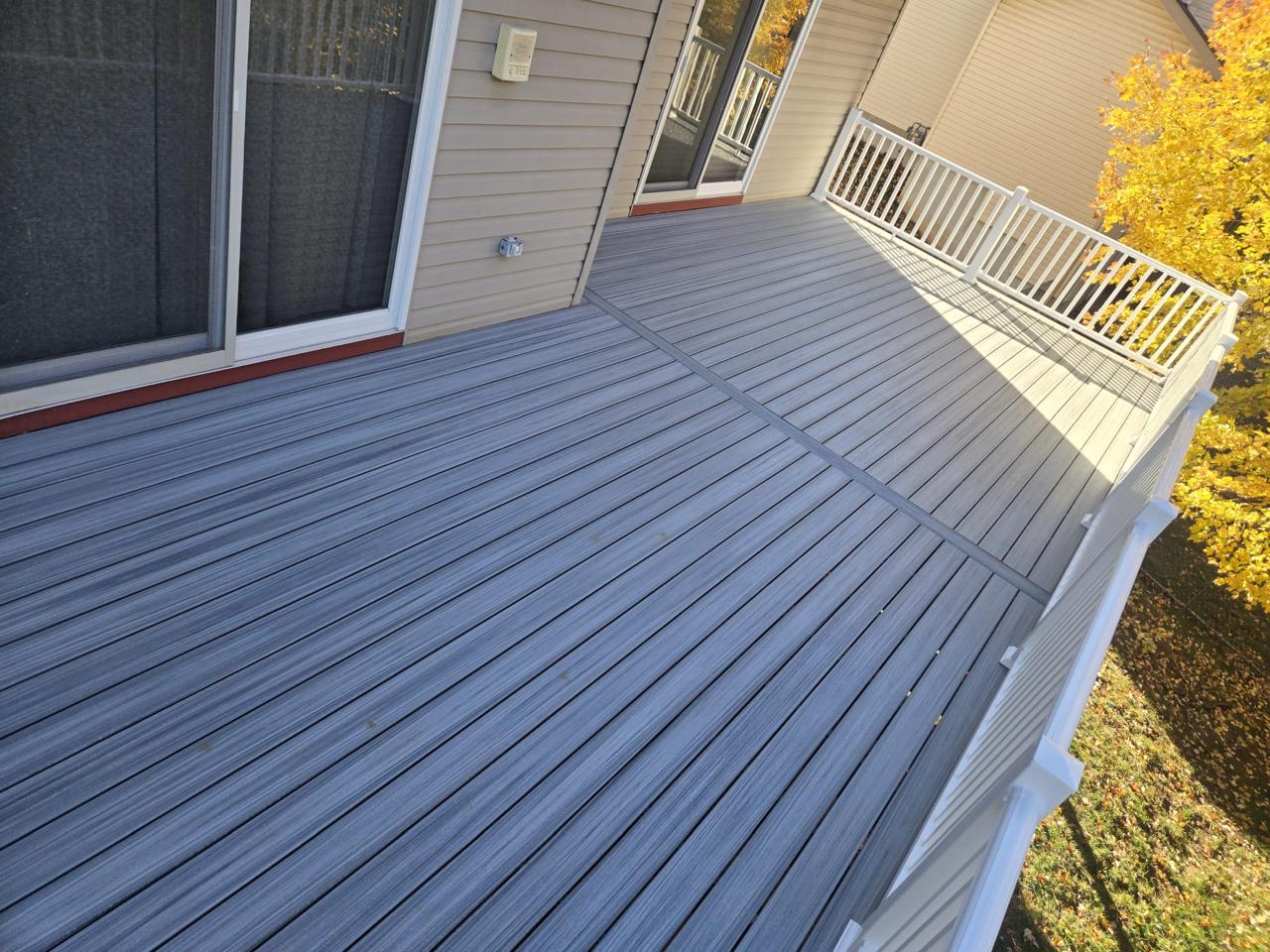
The West Orange job shows a full replacement: a red painted deck with peeling paint and a red railing gave way to gray boards with a white railing. The Hackensack photo, taken during the work, shows gray boards laid with white post sleeves standing and the work area marked off with caution tape. Both are shown in full on our deck projects page.
Restoration keeps the deck and renews its surface. It suits a deck whose frame and boards are sound but whose finish has failed: gray, faded or peeling. The Pompton Plains photos at the top of this page show the whole sequence.
A restoration starts with cleaning, then repairs. Loose or failing coating comes off, fasteners that have popped are reset, split or soft boards are replaced, and the surface is allowed to dry before anything goes on.
Deck boards are usually pressure-treated wood, a naturally decay-resistant wood such as cedar or redwood, or composite, a board made from wood fiber and plastic. The right choice depends on budget, on how much upkeep you want and on what the deck looks out on.
Wood costs less up front and has a natural look, but it needs regular care. Composite costs more at the start and needs no staining; it needs washing, and in full summer sun dark boards can get hot underfoot.
Whichever material is used, the frame is usually wood, and the life of the frame matters as much as the life of the boards.
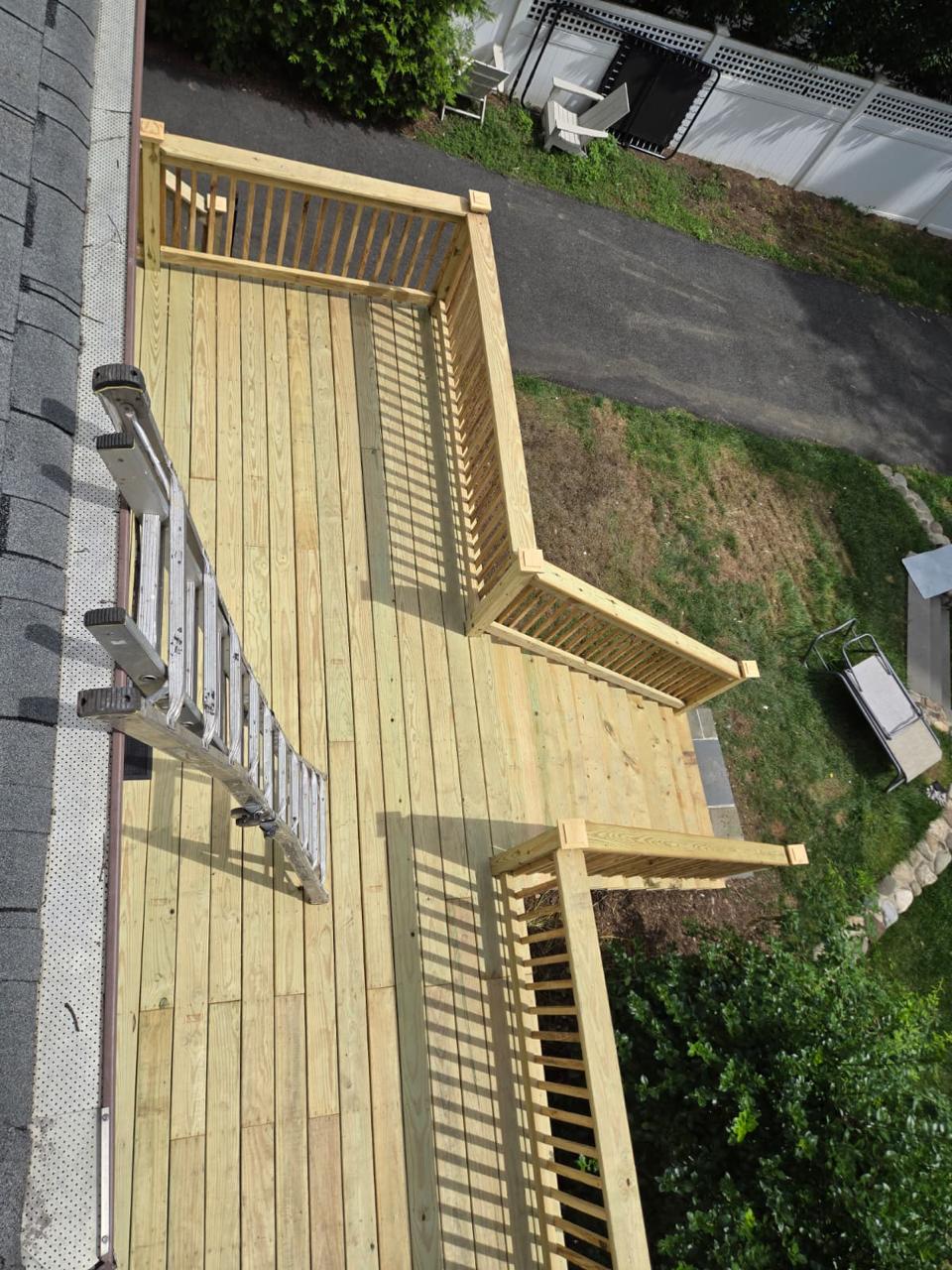
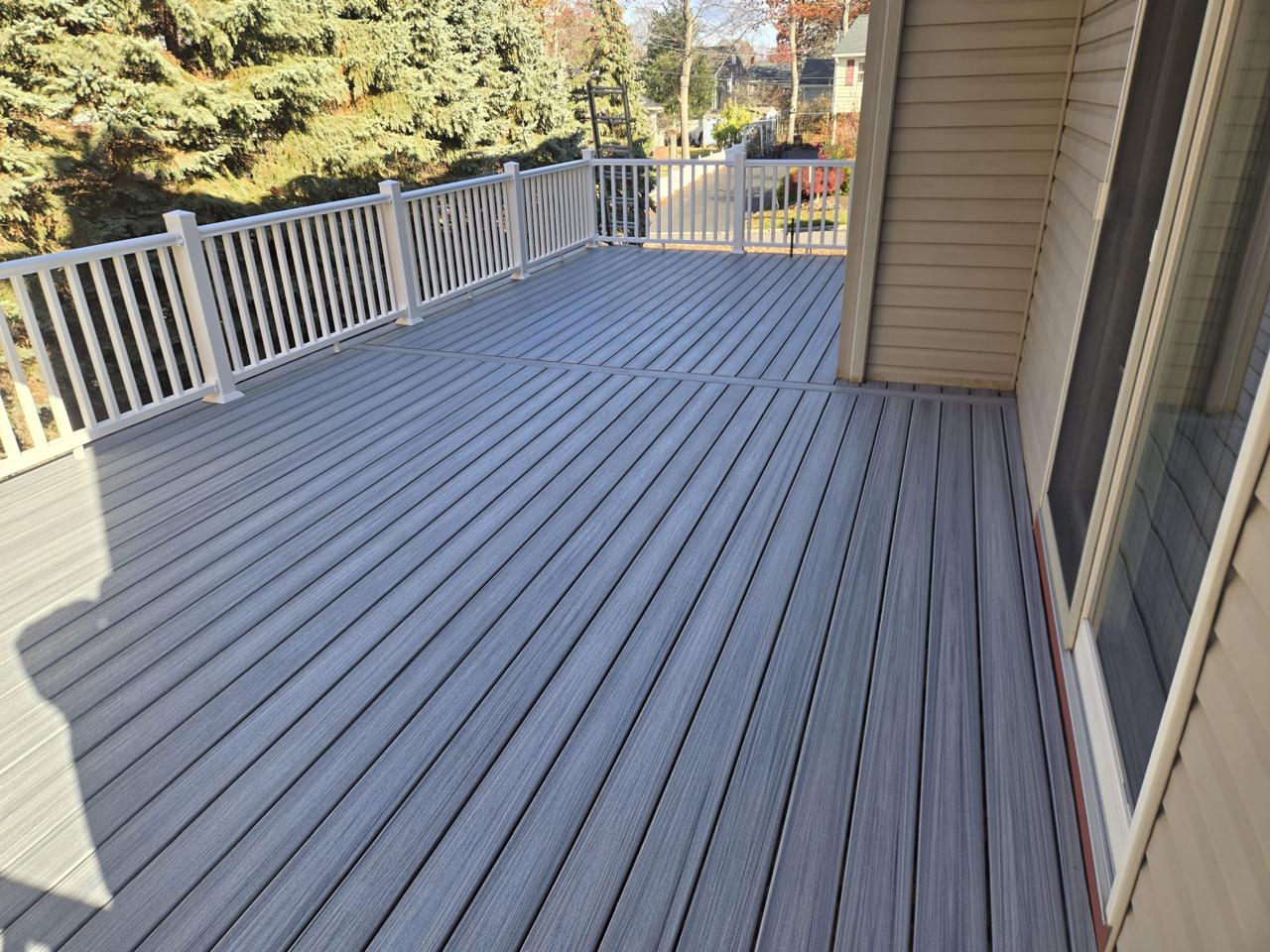
Wood and composite compared.
| Wood | Composite | |
|---|---|---|
| Upkeep | Seal or stain about every 2 to 3 years | Wash as needed; no staining |
| Look | Natural grain that changes color over time | Even color, in many finishes |
| In direct sun | Cooler underfoot | Can get hot, especially in darker colors |
| Fastening | Screws or nails through the face, or clips | Often clips along the sides, depending on the product |
WoodSeal or stain about every 2 to 3 years
CompositeWash as needed; no staining
WoodNatural grain that changes color over time
CompositeEven color, in many finishes
WoodCooler underfoot
CompositeCan get hot, especially in darker colors
WoodScrews or nails through the face, or clips
CompositeOften clips along the sides, depending on the product
A railing is a safety part first and a design part second. Under the model codes, a guard is called for where the walking surface is more than 30 inches above the ground. On a deck it must be at least 36 inches tall, with no opening that a 4-inch sphere can pass through. Local codes can differ, so check with your town.
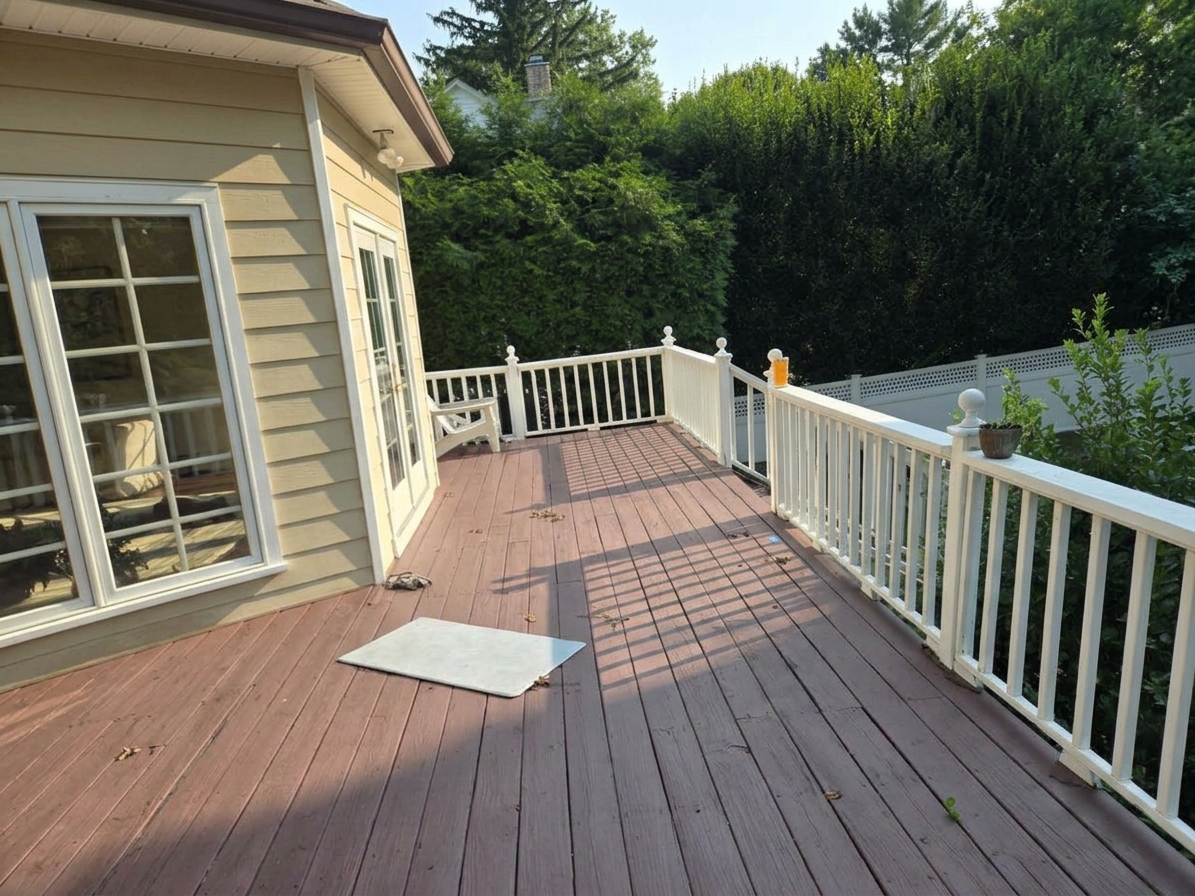
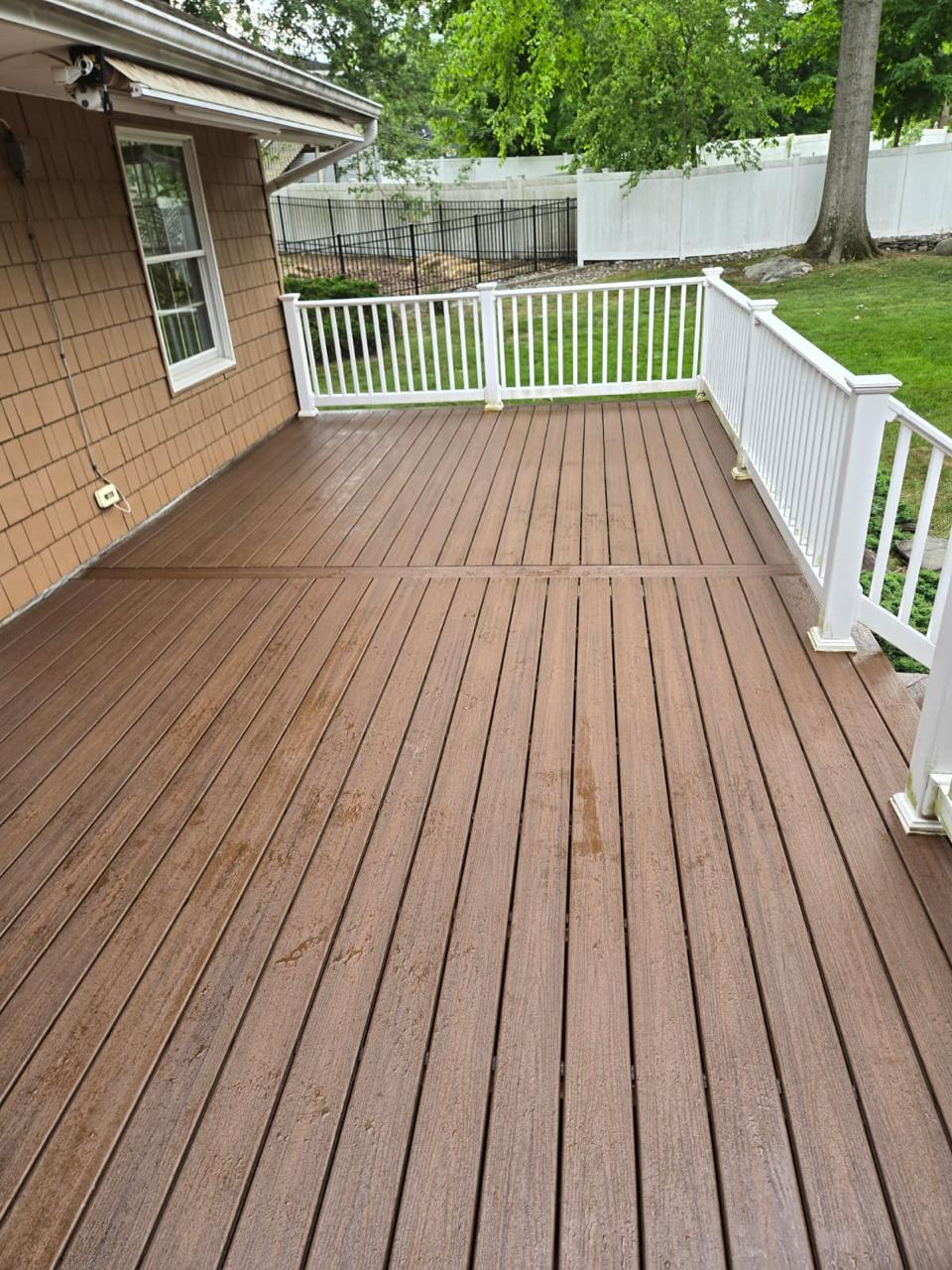
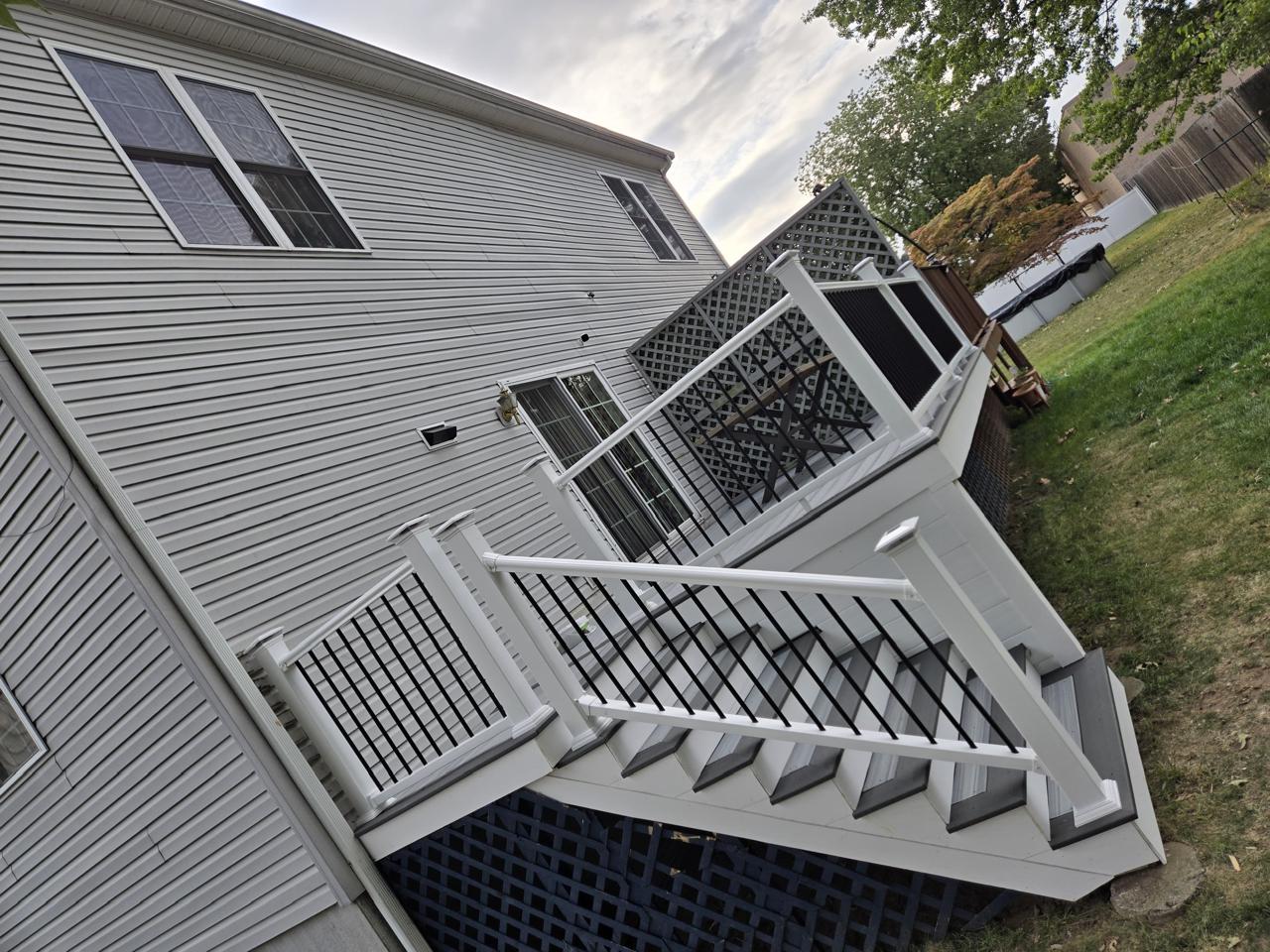
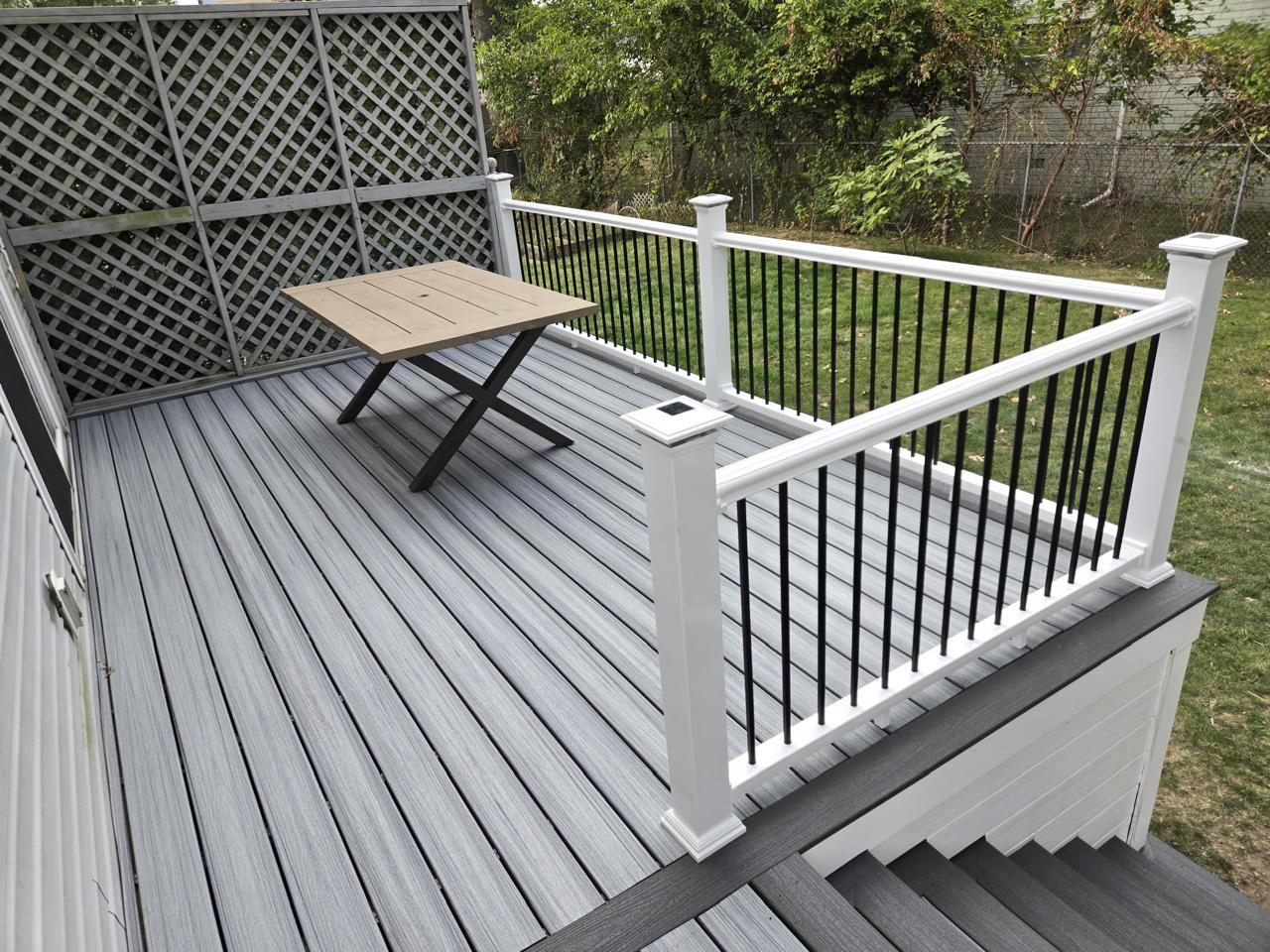
Railings are made in wood, vinyl or PVC, aluminum and composite, and with cable or glass infill. The photos here show several looks: a white railing at the corner of a raised deck in Oradell, white rails with black round balusters in Hackensack, white rails with ball-topped posts in Wyckoff and a white railing on a brown deck in Wayne.
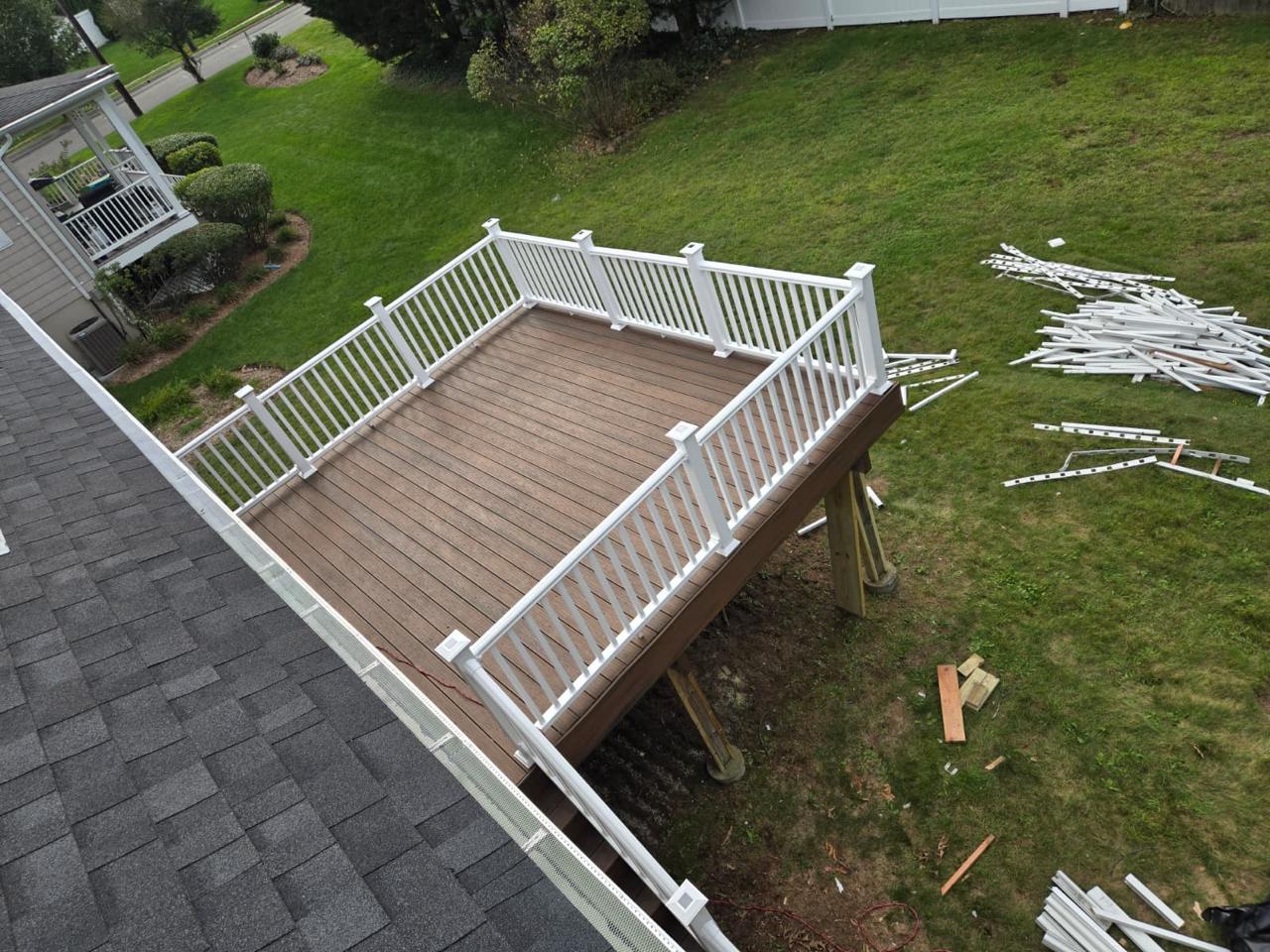
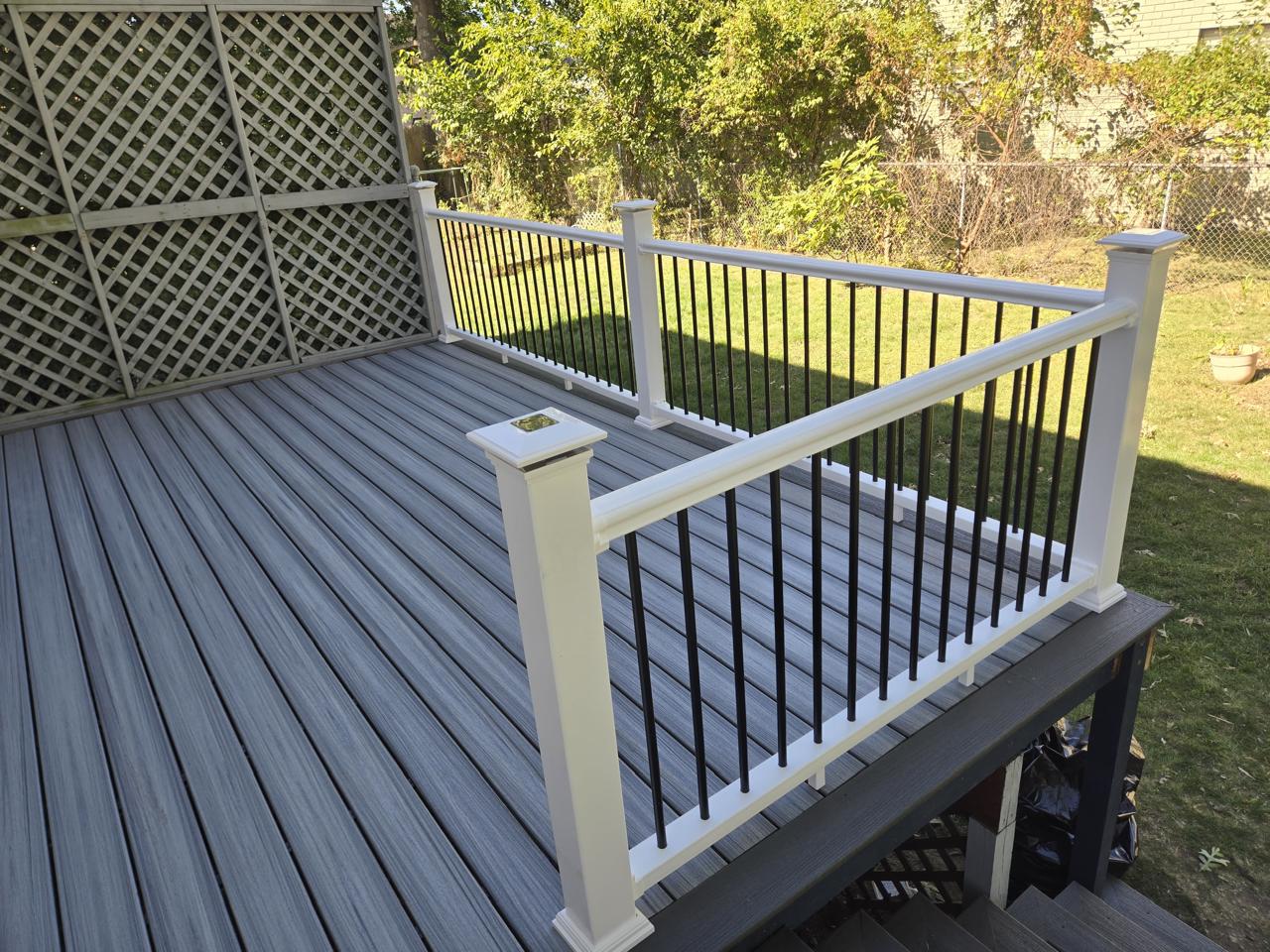
Deck stairs are where many deck falls happen, so they get the same attention as the deck. Risers are limited to about 7-3/4 inches, treads must be at least 10 inches deep and the steps in one flight must match within 3/8 inch.
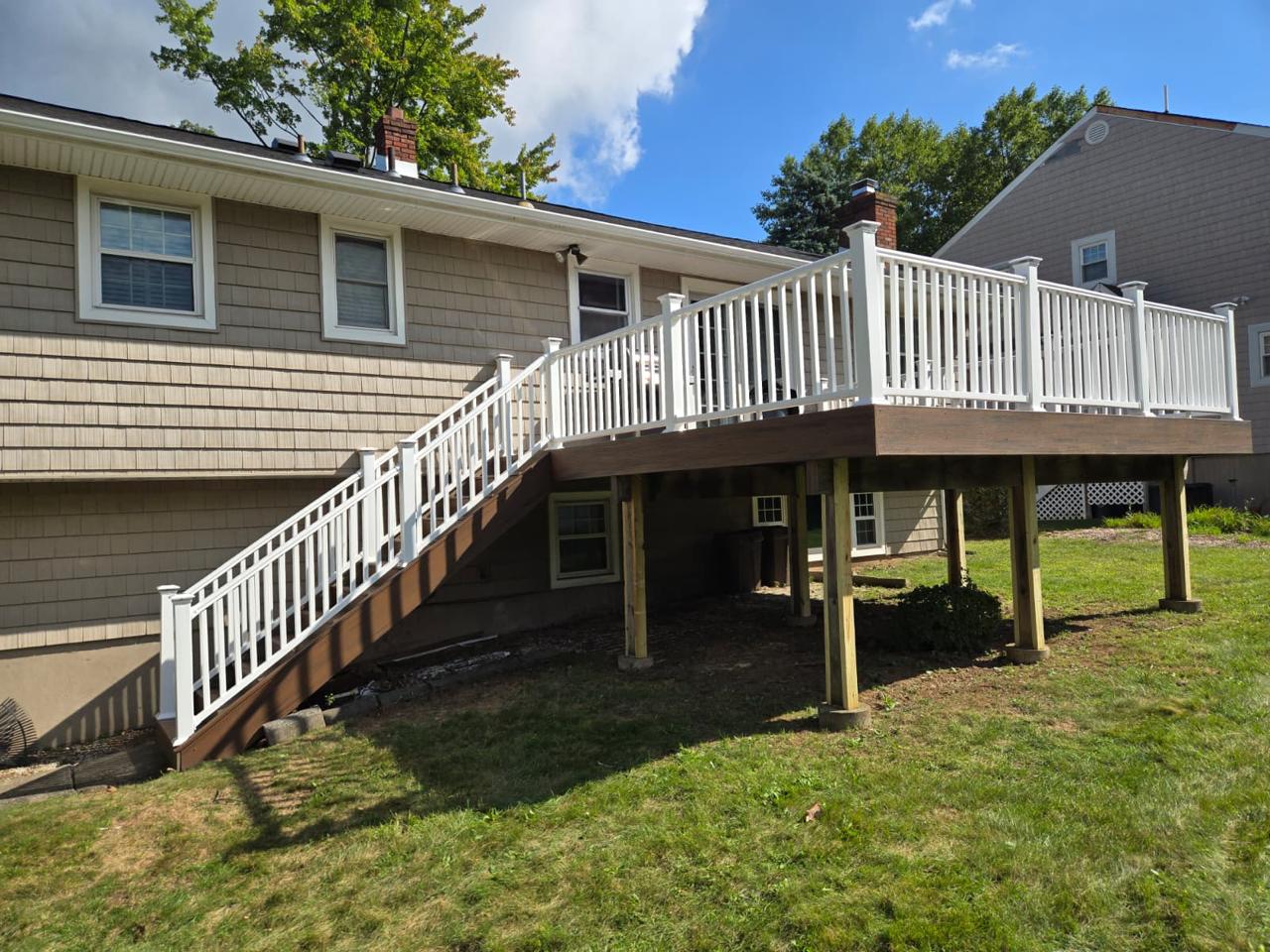
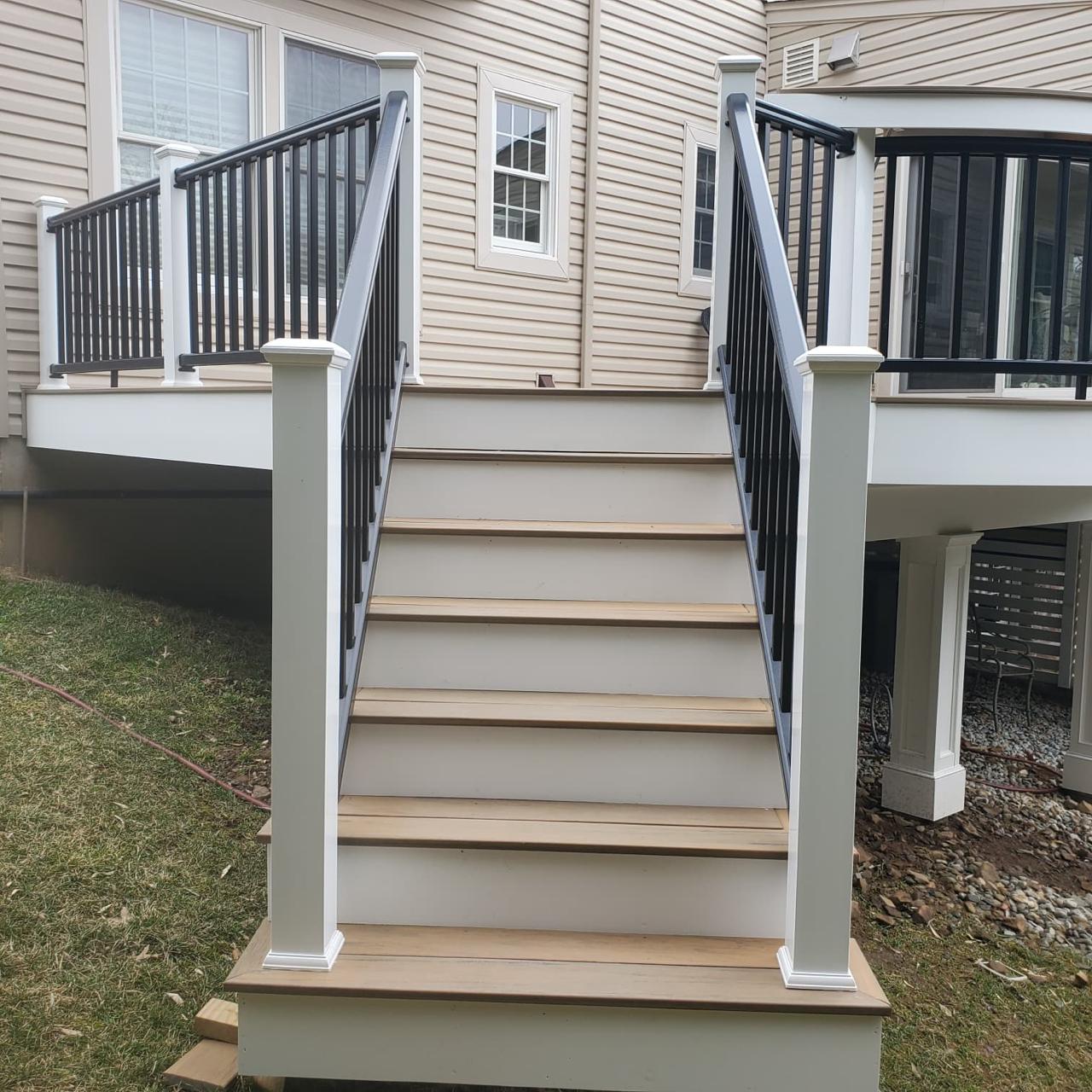
Stairs also need to land on something firm: a footing, a concrete pad or a patio, not bare soil. The Clifton photo shows wood steps with handrails. The Oradell stairs run along the house to the lawn, and the Wyckoff stairs repeat the white posts and black balusters.
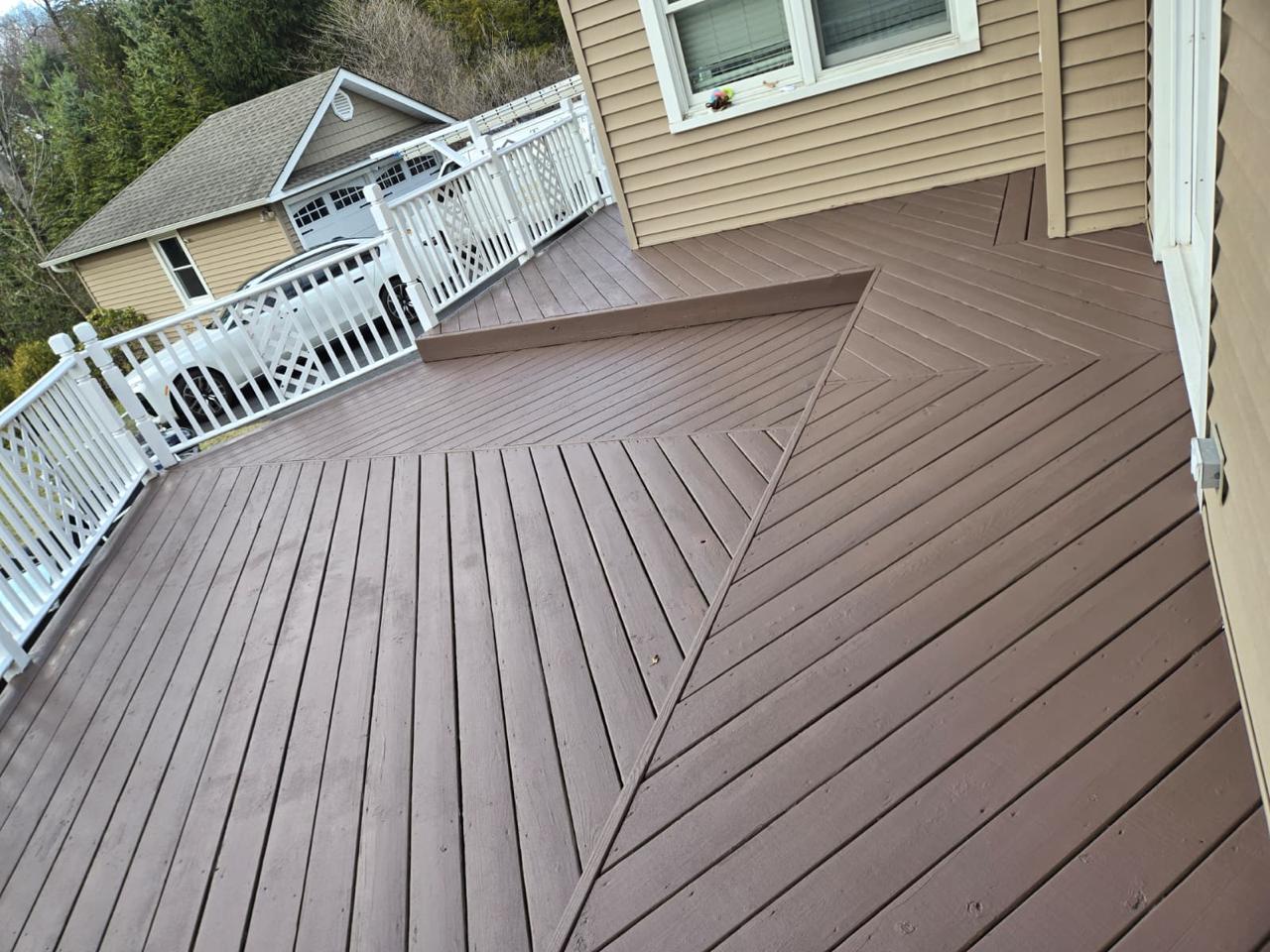
Boards do not have to run in one direction. A deck can be laid straight, on a diagonal, in a chevron or herringbone pattern, or with a border of boards in a second color that frames the edge.
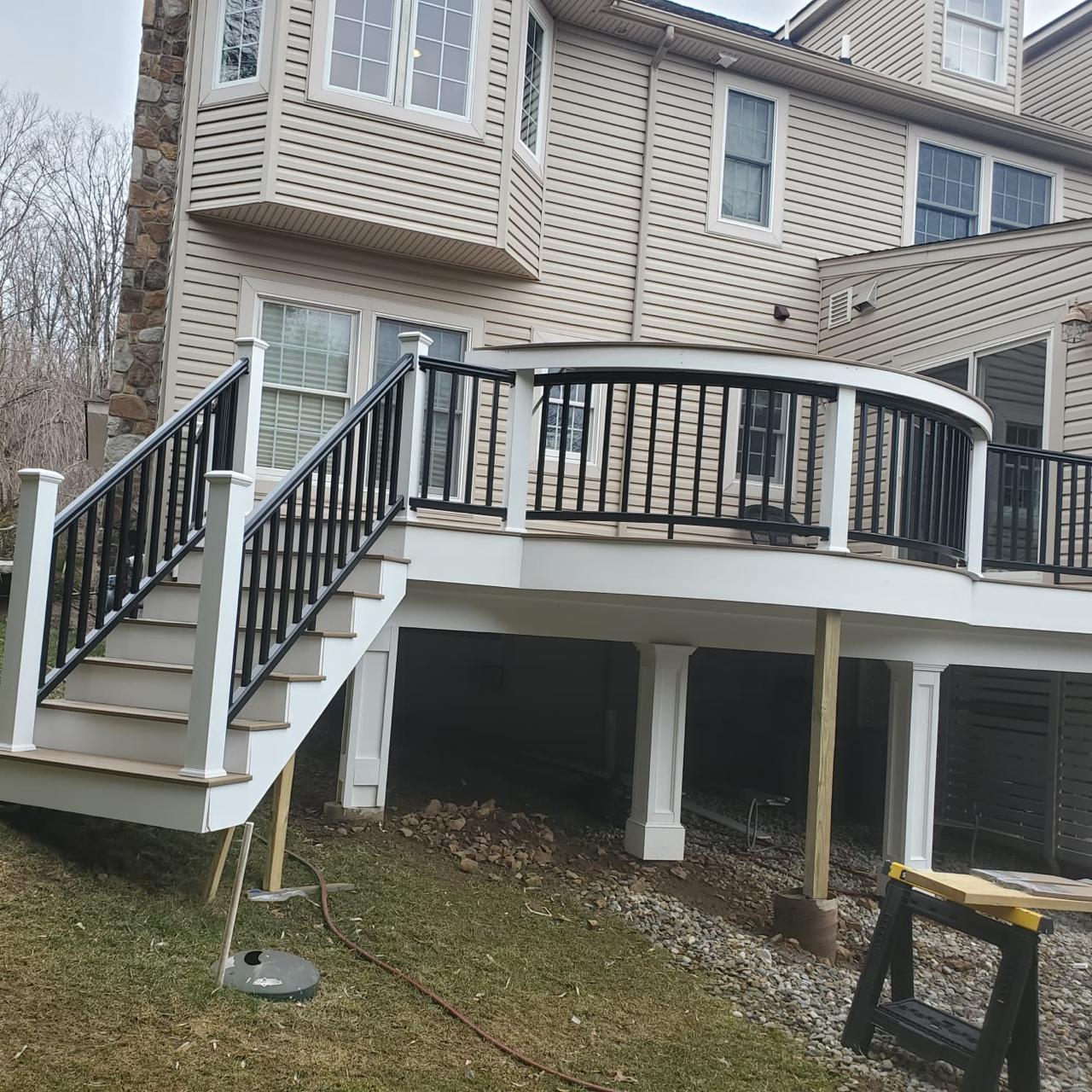
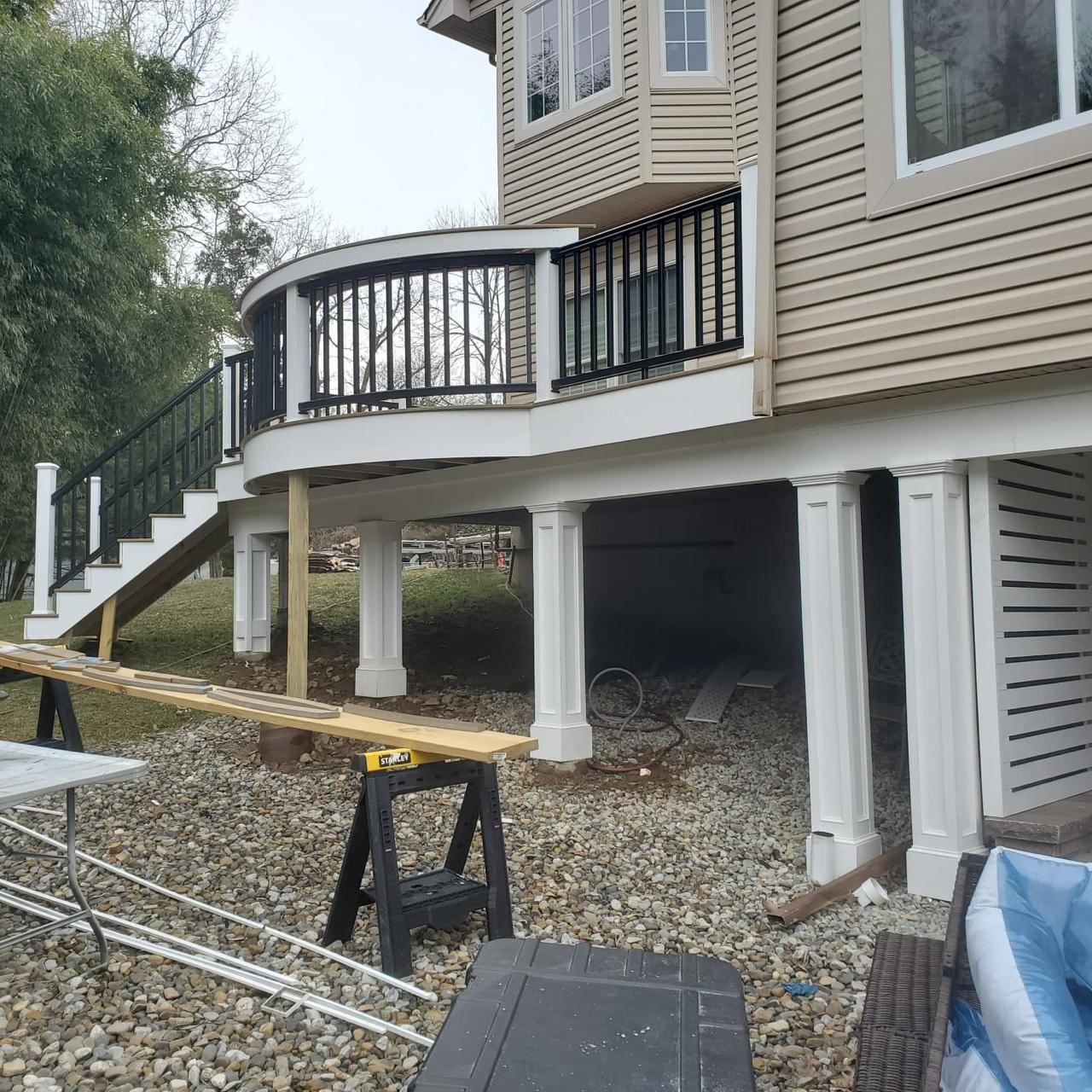
The Ridgewood photo shows boards laid in a chevron pattern on a brown deck with a white railing and lattice panels. The Wyckoff deck has an arc along its outer edge, and the railing follows it with a wood-look bar across the top.
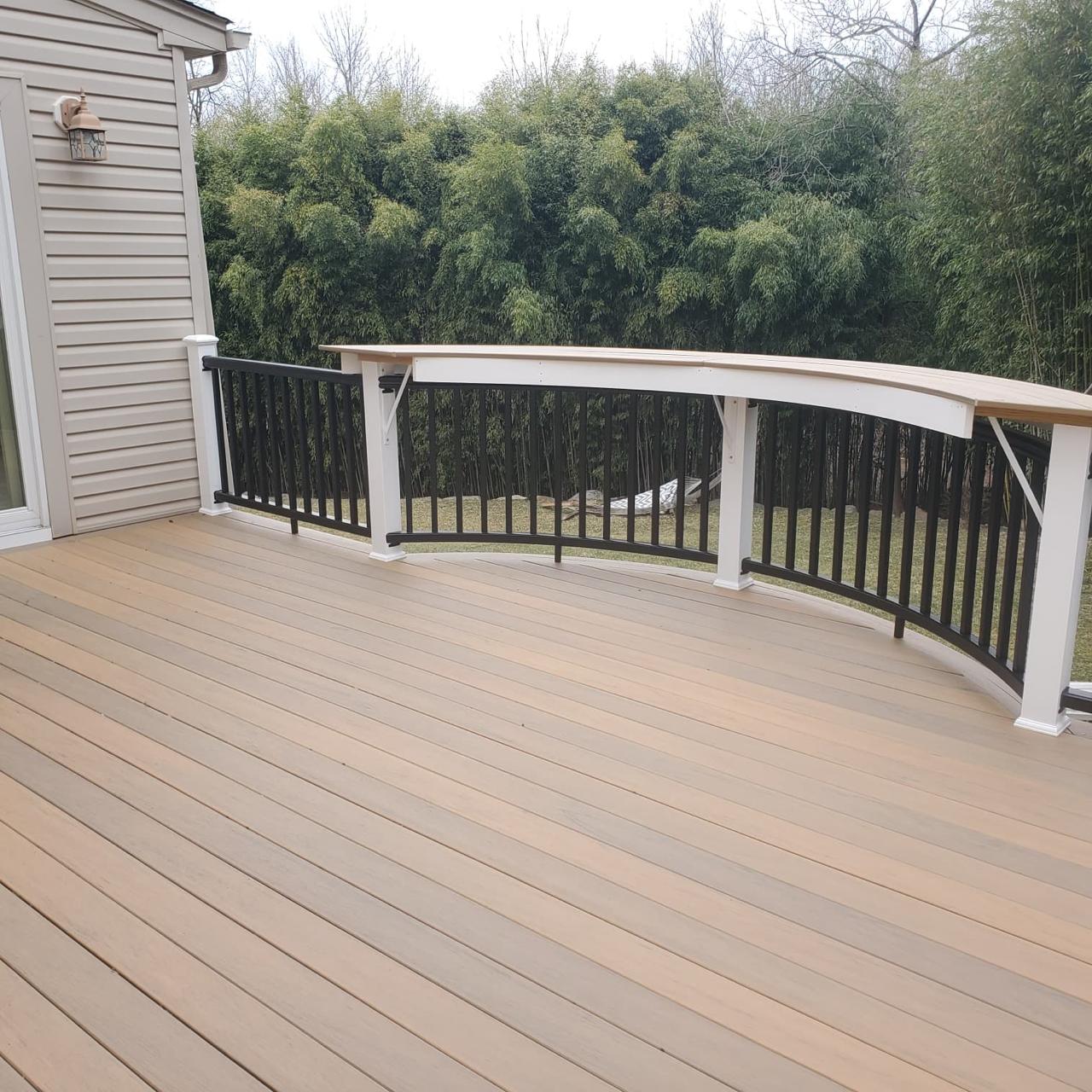
The space under a raised deck is easy to ignore and easy to improve. Skirting or lattice closes it in so animals cannot nest there, hides the posts and joists, and gives the deck a finished look from the yard. It has to be built to let air move through.
The Hackensack photo shows lattice skirting under a gray deck with its stairs. The Wyckoff photo shows white columns standing under the curved edge of a deck.
A deck can be added to as well as repaired. Common upgrades are a larger footprint for more seating space, built-in benches and planter boxes, better stairs or a second set of stairs, a new railing, privacy screens or lattice panels, and lighting built into posts, stairs or the railing.
Expanding a deck is mostly a framing question: the new section needs its own footings and a tie to the existing frame. Built-in seating, planters and lighting are easier to plan into a new surface than to add later.
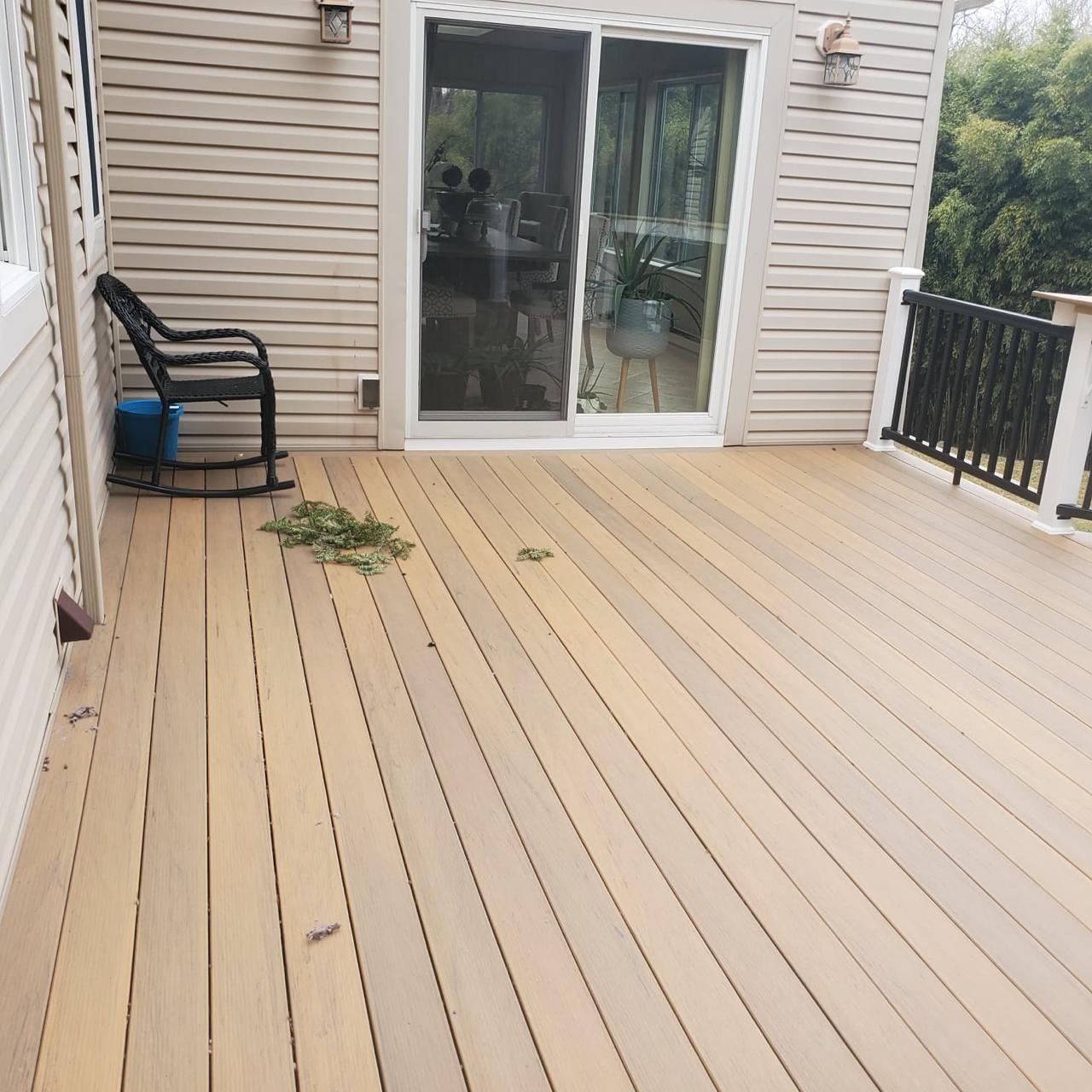
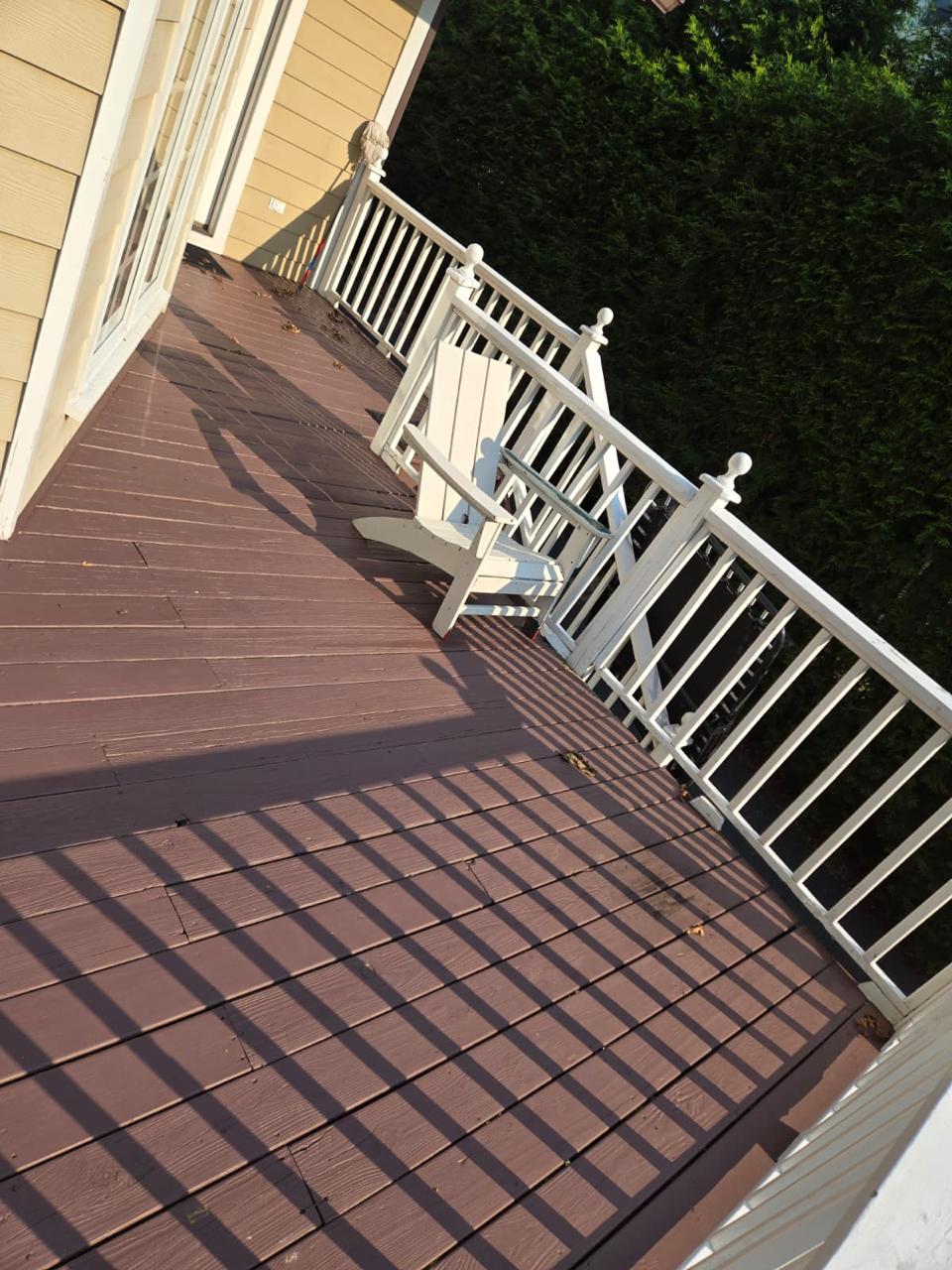
Not every problem is a rebuild. Loose or split boards, popped fasteners, a wobbly railing, a rotted stair tread and a soft spot can often be fixed in place. The key is to find the cause.
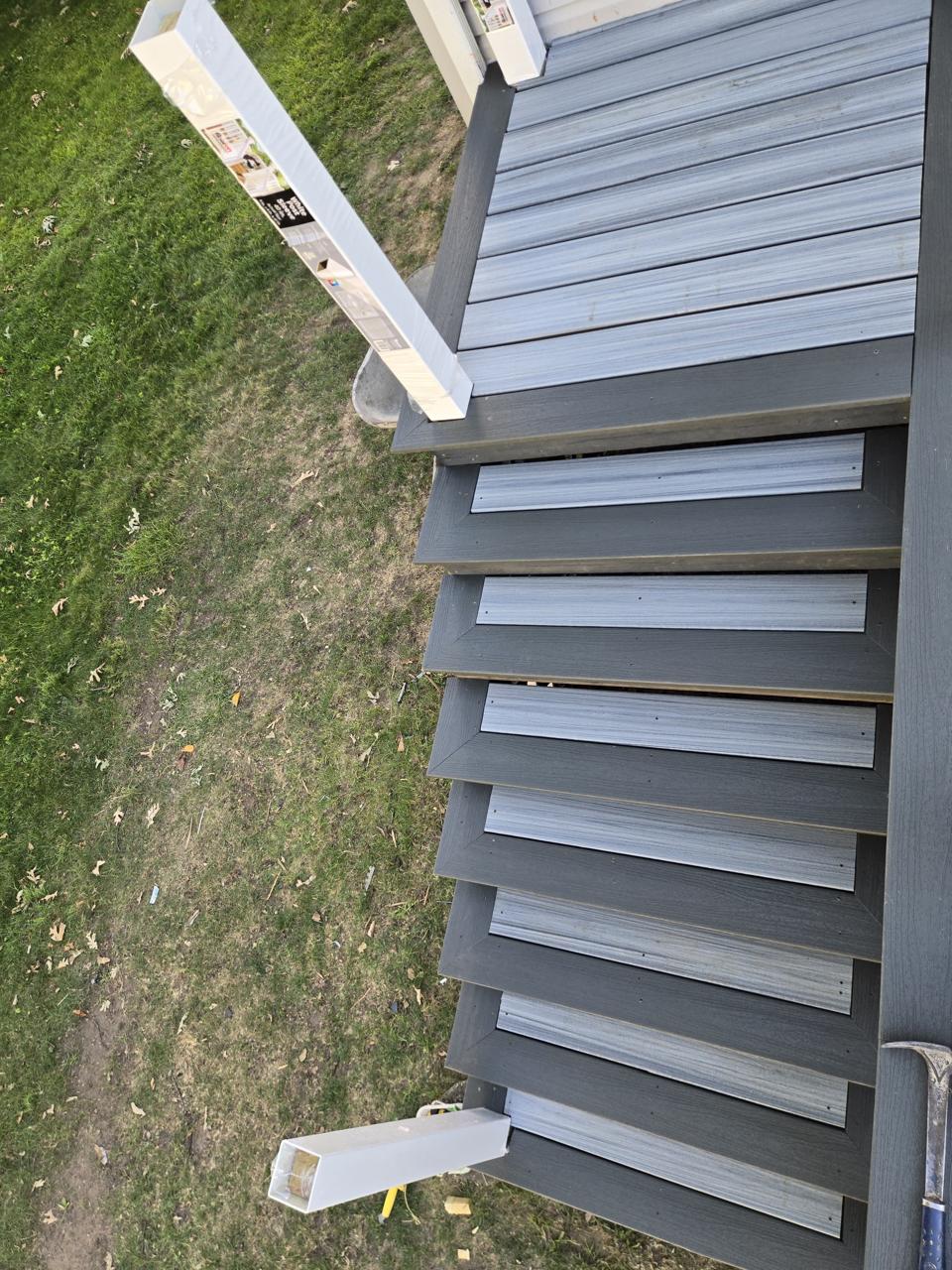
Railing replacement is a repair we do often. The Oradell photos show it in stages: the old railing removed, with bare posts and the old white pieces on the lawn, and boxed white railing sections and posts stacked on the deck.
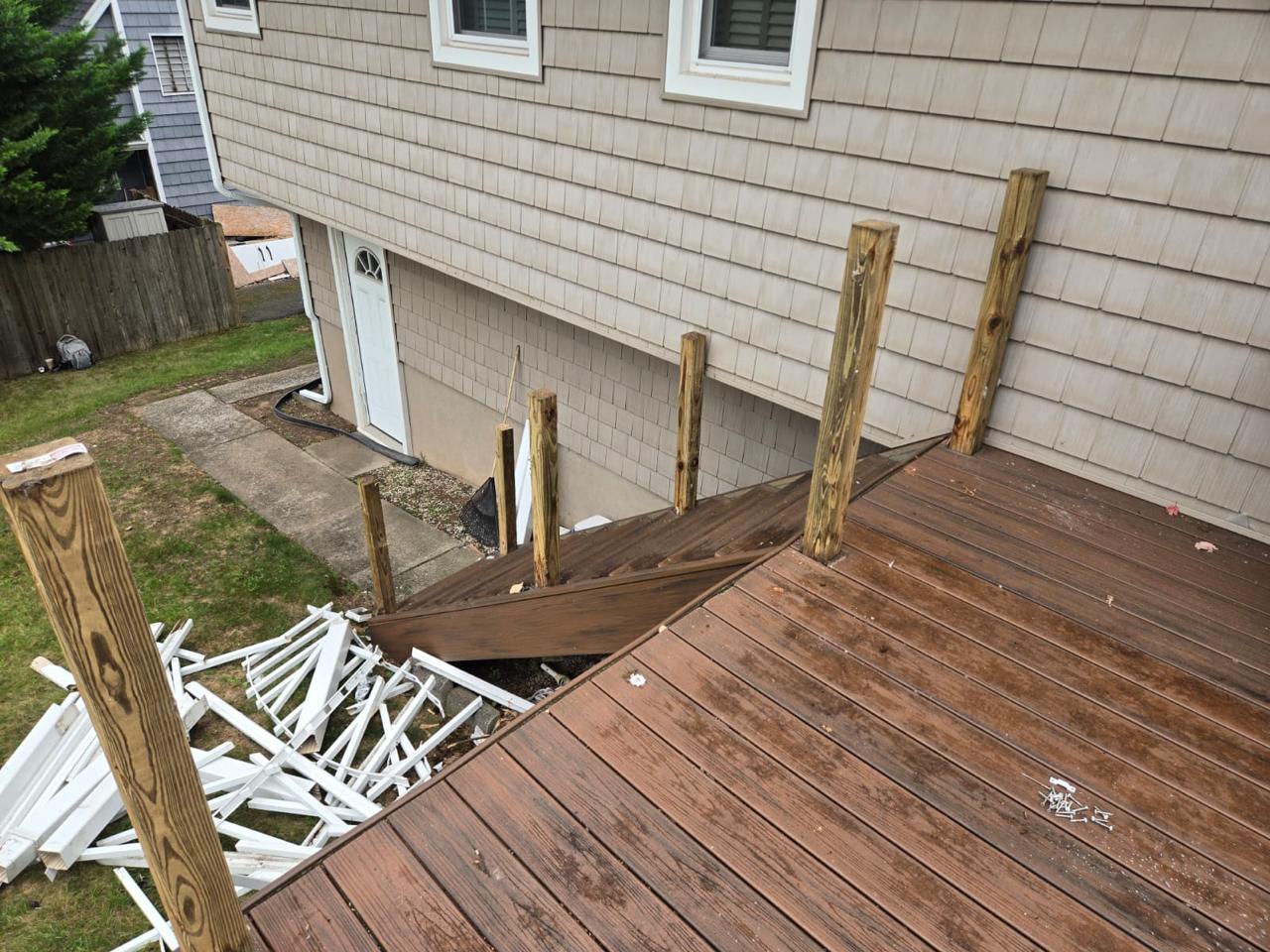
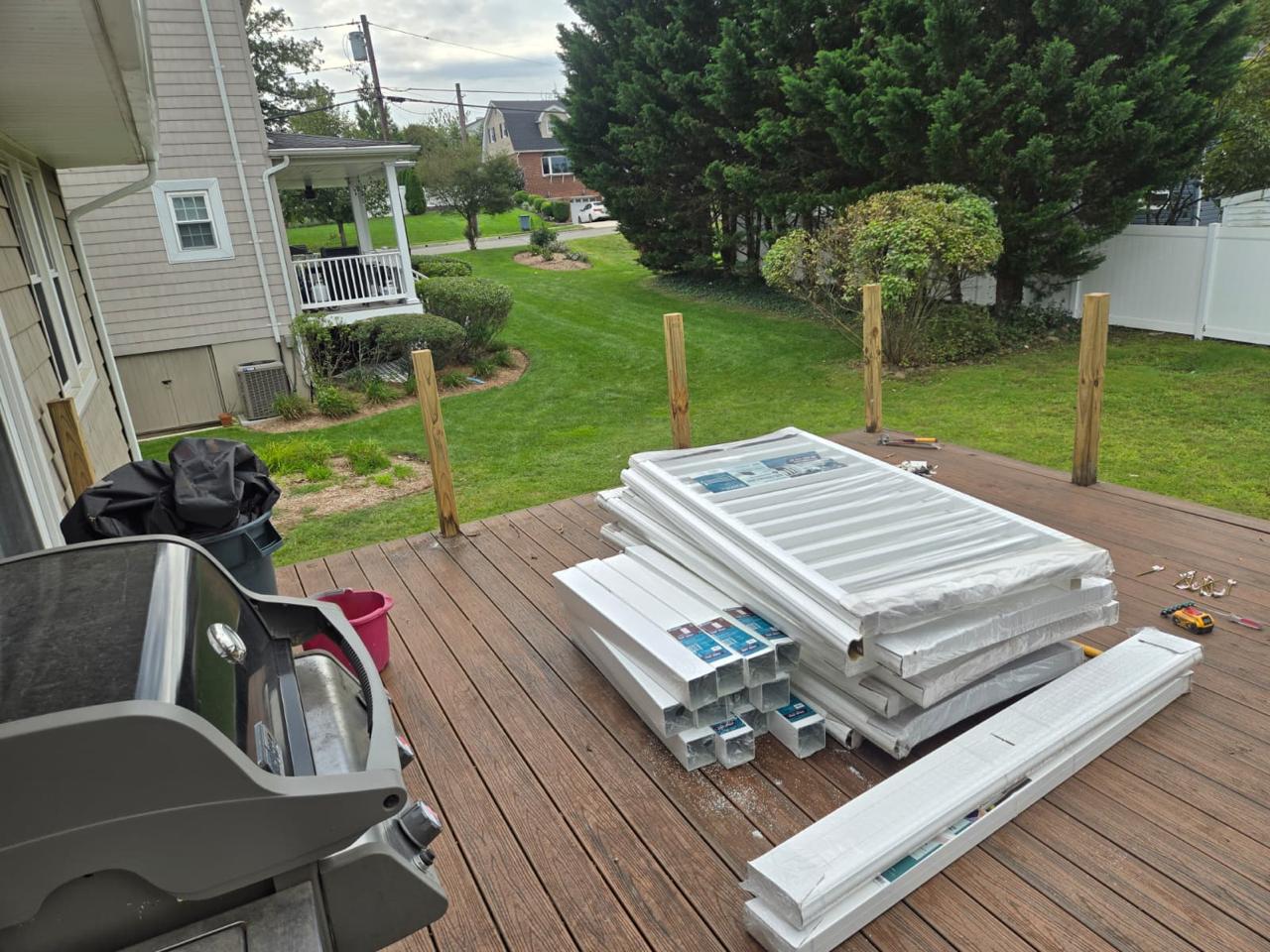
A deck check works from the house out and from the ground up. The ledger and its flashing come first. Then come the connectors and hangers, the posts and their bases, the footings, the joists and beams, the boards, the railing and the stairs.
A screwdriver pushed into a joist or post shows whether the wood is soft. Rust at hangers and bolts points to moisture. A railing that moves when pushed should be fixed before the next gathering.
We do not quote a price without seeing the deck, and a general number would mislead you, because deck jobs vary widely. What moves the cost most is the size, the height above the ground, the material for boards and railing, the shape and the number of stairs.
Other factors are how much of the old deck has to come out and be disposed of, the condition of the frame, whether footings must be dug or added, the permit and inspection, the finish, upgrades such as lighting or built-in seating, and access to the yard.
A good estimate lists these items one by one so that two quotes can be compared line by line.
Building rules for decks come from two places. The state sets the building code, the Uniform Construction Code, and each town enforces it through its construction office. The town also sets zoning rules, such as how close a deck may be to a property line and how much of a lot may be covered.
New decks and complete replacements are generally treated as construction work that needs a permit and inspections. Repairing or replacing part of a deck with identical or closely similar materials in the same location is generally treated as ordinary maintenance under the state code. Rules change and towns differ, so confirm with your town.
Call the construction office of your town before the work starts and ask whether a permit is required, which inspections are needed and whether zoning approval is needed.
Most of what ruins a deck is water, sun and dirt. Sweep leaves and debris out of the gaps between the boards, wash the surface once or twice a year with a deck cleaner and a soft brush, keep planters and mulch from sitting directly on the boards, and trim shrubs so air and light reach the deck.
Wood needs a finish. Composite needs no staining, but it still needs washing, and it can show mildew in shade. Metal parts such as railings, fasteners and connectors need an annual look for rust.
One soft board does not always mean a new deck. This is how the three cases usually differ.
Repair, resurface or rebuild.
| Repair or restore may be enough | Resurfacing is worth discussing | Rebuilding is worth discussing | |
|---|---|---|---|
| Frame | Sound | Sound | Soft, rotted or sagging |
| Ledger at the house | Bolted or lag-screwed and flashed | Bolted or lag-screwed and flashed | Nailed alone, poorly flashed or pulling away |
| Posts and footings | Steady | Steady | Moving, rotted or heaving |
| Deck boards | A few damaged boards or a failing finish | Worn, splintered or faded across the deck | Rotted through or the layout no longer fits |
| Stairs | A worn tread or two | Rebuilt along with the surface | Stringers rotted or stairs unsafe |
Repair or restore may be enoughSound
Resurfacing is worth discussingSound
Rebuilding is worth discussingSoft, rotted or sagging
Repair or restore may be enoughBolted or lag-screwed and flashed
Resurfacing is worth discussingBolted or lag-screwed and flashed
Rebuilding is worth discussingNailed alone, poorly flashed or pulling away
Repair or restore may be enoughSteady
Resurfacing is worth discussingSteady
Rebuilding is worth discussingMoving, rotted or heaving
Repair or restore may be enoughA few damaged boards or a failing finish
Resurfacing is worth discussingWorn, splintered or faded across the deck
Rebuilding is worth discussingRotted through or the layout no longer fits
Repair or restore may be enoughA worn tread or two
Resurfacing is worth discussingRebuilt along with the surface
Rebuilding is worth discussingStringers rotted or stairs unsafe
A professional look tells a local problem from one that runs through the whole deck. Eagle 1 builds, resurfaces, restores and repairs decks. Request an estimate and describe what you see.
Request an estimateIt depends on the size, height, material, shape, stairs, railing and permit, so we do not give a number without seeing the site. Send photos and measurements, or request an estimate, and we will tell you what we need. The cost chapter above lists what an estimate should include.
New decks and complete replacements generally need a permit and inspections. Repairing or replacing part of a deck with identical or closely similar materials in the same location is generally ordinary maintenance under the state code. Zoning rules such as setbacks are set by your town, so call your construction office before the work starts.
Often, yes, if the frame is sound. This is called resurfacing. The frame, ledger, posts and footings are checked first, because new boards are only as good as what they sit on.
Check the frame first. Soft or rotted joists, a ledger that is pulling away, posts that move or heavy rust at the connectors point to rebuilding. Worn boards on a sound frame can be resurfaced, and a failing finish on sound wood can be restored. Our repair, resurface or rebuild table sets out the signs.
Neither is better in every case. Wood costs less up front and needs sealing or staining every few years. Composite costs more, needs no staining, and industry guides put its life at about 25 to 30 years or more, against about 10 to 20 for wood. Composite can get hot in direct sun.
Industry guides put wood decking at about 10 to 20 years. The real figure depends on the lumber, sun and shade, drainage and upkeep, and regular cleaning and a good finish help it last.
Under the model codes a guard is called for where the walking surface is more than 30 inches above the ground, and on a deck it must be at least 36 inches tall. Local codes can differ, so check with your town.
No opening in a guard may let a 4-inch sphere pass through. The open side of a stair has its own limit. Check your local code.
A flight of four or more risers generally needs a handrail on at least one side, set between 34 and 38 inches high and shaped so you can grip it. Risers and treads must also be even from the top of the flight to the bottom.
It is the board fastened to the frame of the house that carries one edge of the deck. It should be bolted or lag-screwed to the house framing, not just nailed, and flashed so water cannot get behind it. A poorly attached ledger is a known cause of deck failures.
Yes. Our Wyckoff job has a curved outer edge with a railing that follows it. A curve takes more design and framing than a straight edge, so send us a sketch or a photo of what you have in mind.
Yes. Our Oradell job shows the old railing removed, the bare posts standing and the new white railing in place, with the deck boards in place.
If the frame and boards are sound, yes. Our Pompton Plains job shows a weathered deck and stairs cleaned, recoated and finished with a white railing. A restoration does not fix a rotten board or a weak frame.
Yes. These are common additions and they are easier to plan into a new surface than to add later. Wired lighting may need a separate electrical permit, so we will talk through the options with you.
Yes. Stairs are one of the most common deck repairs and changes. They need even steps, a firm landing and a handrail you can grip.
We serve North Jersey, including Passaic, Essex, Bergen, Morris, Hudson, Union, Sussex and Warren counties.
Use the Request an estimate button or call 973-935-6329. Tell us your town, the size and kind of deck you have or want, and what you are seeing. Photos help.
Send us a photo, your town and a rough idea of the size and we will tell you what we would do.